I must admit that, often, when we sit down to write a new issue of estrategIA, we fall into the expert's trap. As we analyse the sector's latest moves and bring you new developments, we assume everyone knows where each model comes from, which company is behind it and the geopolitical significance of a new release. We also assume that the importance of every name in the news is obvious. Take Anthropic, for example: the central player in this week's most significant AI-and-government story, perhaps even the year's, which we hope to analyse once more information is available and the dust has settled. Yet the reality is very different, even among people like you who try to keep up with AI news.
We see this constantly in ALEPH Educational Institution's classrooms. Teaching AI to our postgraduate students makes the gap clear. A vast group of professionals simply gets into the AI “car” without knowing much about what is under the bonnet. They know it works, press the accelerator and use it day to day, but do not know who makes the engine or the philosophy behind its design.
This is where the motoring metaphor becomes particularly useful. Mastering this technology in public management, business or communication requires being a very good driver: knowing how to structure requests, understanding the machine's logic and thinking critically. But, as in Formula One, even an exceptional driver cannot make the most of their talent without one of the best cars, and without knowing how to tune it for each race.
Choosing the best model makes a difference. Doing so also requires knowing most of generative AI's major “manufacturers”. Today, therefore, we pause to take stock of the sector at the start of 2026 and offer concise profiles of twelve key players, selected primarily for their impact on model development or deployment. That focus leaves out several AI giants, including Nvidia, AMD, Microsoft and Amazon.
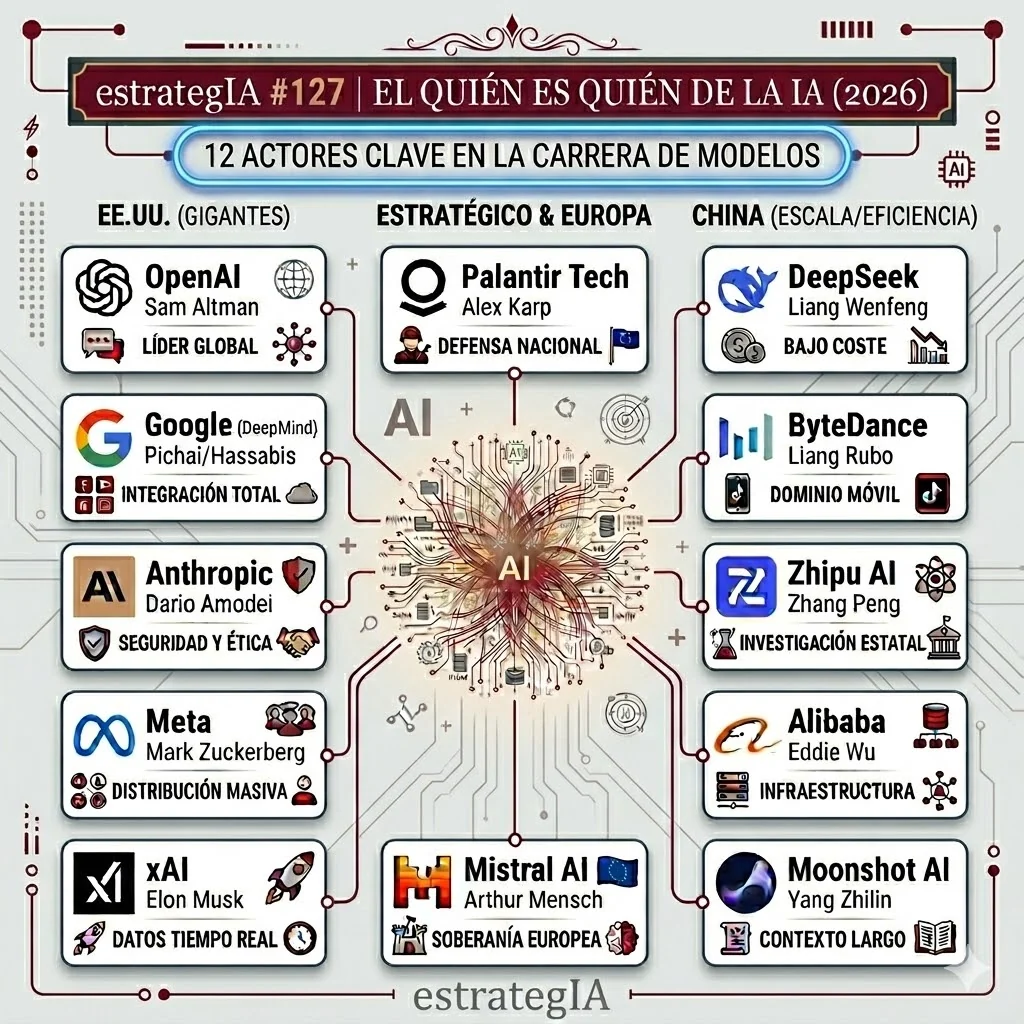
The original “Who's who in AI (2026)” graphic groups twelve players as follows. US giants: OpenAI/Sam Altman, global leader; Google/DeepMind/Pichai and Hassabis, total integration; Anthropic/Dario Amodei, safety and ethics; Meta/Mark Zuckerberg, mass distribution; xAI/Elon Musk, real-time data. Strategic and European actors: Palantir/Alex Karp, national defence; Mistral/Arthur Mensch, European sovereignty. China, scale and efficiency: DeepSeek/Liang Wenfeng, low cost; ByteDance/Liang Rubo, mobile dominance; Zhipu AI/Zhang Peng, state research; Alibaba/Eddie Wu, infrastructure; Moonshot AI/Yang Zhilin, long context. These are the source's historical categories and labels.
The US ecosystem: the giants
1. OpenAI
- Leadership: Sam Altman, CEO.
- Corporate scale: heading above $850 billion in its latest funding round, with projections pointing towards $1 trillion, while maintaining an extraordinary annual cash burn exceeding $17 billion.
- Product scale: between 800 and 900 million weekly active users.
- Public significance: mass adoption and a de facto professional standard.
- Background: founded as a laboratory in 2015, it now sets the global pace. After triggering the current wave with ChatGPT, its strategy focuses on establishing autonomous agents for knowledge work.
- Main text/reasoning models: the GPT-5.2 family, with Instant, Thinking and Pro variants.
- Leading image/video products: a benchmark in synthetic media, with Sora 2/Sora 2 Pro for video and GPT Image 1.5.
2. Google (DeepMind)
- Leadership: Sundar Pichai, Alphabet CEO, and Demis Hassabis, DeepMind CEO.
- Corporate scale: the enormous backing of Alphabet's market capitalisation.
- Product scale: more than 750 million monthly active users of the Gemini app, alongside intensive API use.
- Public significance: vast infrastructure and global ubiquity.
- Background: its structural advantage is not just the model, but the ecosystem. It no longer competes solely on technical performance, but on comprehensive integration across Search, Workspace, Android and Cloud.
- Main text/reasoning models: Gemini 3.1 Pro and Flash variants in the Gemini 3 family.
- Leading image/video products: Veo 3.1 for video and Imagen 3.
3. Anthropic
- Leadership: Dario Amodei, CEO.
- Corporate scale: a recent $380 billion Series G valuation, almost double its already extraordinary previous $183 billion round.
- Product scale: strong penetration of professional environments, coding and corporate use.
- Public significance: enterprise infrastructure, safety and institutional reliability.
- Background: founded by people who broke away from OpenAI. It presents itself as the option for institutions that cannot afford failures, prioritising a highly controllable architecture, safety and ethics.
- Main text/reasoning models: the Claude 4.6 family, Opus and Sonnet, consolidating its leadership in autonomous computer use. Its public product does not focus on image or video generation.
4. Meta
- Leadership: Mark Zuckerberg, CEO, and Alexandr Wang.
- Corporate scale: market capitalisation above $1 trillion.
- Product scale: Meta AI passed one billion monthly active users through its social networks.
- Public significance: global social distribution and the commoditisation of AI.
- Background: initially distinguished itself by giving away the “recipe” for its engines through open weights. Its enormous adoption is tied to its being forcibly embedded in the search bars of Facebook, Instagram and WhatsApp. In late 2025, it underwent substantial restructuring after the departure of its longstanding chief scientist, Yann LeCun.
- Main text/reasoning models: the Llama 4 family.
- Leading image/video work: strong visual-generation research programmes, such as Movie Gen.
5. xAI
- Leadership: Elon Musk.
- Corporate scale: operationally integrated into SpaceX's structure following recent corporate moves.
- Product scale: adoption driven by subscriptions to the social network X.
- Public significance: political, media and increasingly defence influence.
- Background: combines a technological-frontier narrative, extremely rapid deployment and privileged access to real-time data streams.
- Main text/reasoning models: Grok 4.20 Beta, notable for its new multi-agent collaboration capabilities.
Defence and government: the strategic player
6. Palantir Technologies
- Leadership: Alex Karp, CEO.
- Corporate scale: market capitalisation around $307 billion, adjusted for volatility in late February 2026.
- Product scale: deployment in government agencies and large operating businesses.
- Public significance: defence, national security and state operations.
- Background: does not compete as a consumer-facing foundation-model brand. It turns AI into institutional infrastructure by connecting major models with classified data and complex organisational processes.
- Key products: AIP, Artificial Intelligence Platform, and Gotham.
The European alternative
7. Mistral AI
- Leadership: Arthur Mensch, CEO.
- Corporate scale: the European Union's leading AI unicorn.
- Product scale: strong adoption among developers and in European business-to-business integrations.
- Public significance: European technological sovereignty and the open-weight ecosystem.
- Background: founded in Paris, it defines itself as an efficient, open alternative to closed platforms. Particularly attractive to institutions requiring complete control over their deployments.
- Main text/reasoning offering: an ecosystem centred on its API, Le Chat, Mistral Code and Mistral Compute.
The Chinese ecosystem: scale and efficiency
8. DeepSeek
- Leadership: Liang Wenfeng.
- Corporate scale: connected to the High-Flyer quantitative fund.
- Product scale: strong global traction through the web and API, driven by aggressive pricing.
- Public significance: geopolitical disruption and acceleration of China's AI ecosystem.
- Background: the player that has most changed the conversation in recent months, demonstrating frontier performance on radically smaller budgets than Silicon Valley's. Its current focus prioritises deep-reasoning models.
- Main text/reasoning models: DeepSeek-V3.2 and DeepSeek-R1, with intense market anticipation of a rumoured V4 said to be close to release.
9. ByteDance
- Leadership: Liang Rubo.
- Corporate scale: TikTok's parent company, with vast training resources.
- Product scale: its Doubao assistant exceeded 100 million daily active users at the peak of the recent Chinese New Year campaign.
- Public significance: leadership in mass algorithmic and social consumption in Asia.
- Background: clearly separates its foundational research layer from its end product. It has applied its immense expertise in user retention to dominate the share of attention for mobile generative AI.
- Main text/reasoning offering: the Seed research ecosystem and the consumer-facing Doubao layer.
- Leading image/video products: particularly strong in short-form video generation with Jimeng.
10. Zhipu AI (Z.ai)
- Leadership: Zhang Peng.
- Corporate scale: strategic backing from major Chinese technology companies and institutions.
- Product scale: development of its public Z.ai brand as an international assistant.
- Public significance: excellence in state and institutional research.
- Background: one of China's most prestigious laboratories, combining a direct-to-consumer product, its own foundation models and international brand expansion.
- Main text/reasoning models: the GLM-5 family.
- Leading image/video products: a strong presence through the CogVideoX model family.
11. Alibaba
- Leadership: Eddie Wu, CEO.
- Corporate scale: the full weight of one of the world's largest cloud and commerce conglomerates.
- Product scale: aggressive user acquisition for its own app in Asia's “chatbot wars”.
- Public significance: enterprise ecosystem and multimodal infrastructure.
- Background: shows that Alibaba is not content merely to distribute cloud capacity. It competes head-on in creating explicitly multimodal, agent-oriented AI.
- Main text/reasoning models: the Qwen 3.5 family, including the new locally runnable version featured as this original issue's particularly interesting tool of the week.
12. Moonshot AI
- Leadership: Yang Zhilin.
- Corporate scale: a frontier startup founded in 2023, with strong investor backing.
- Product scale: a growing niche community focused on technical use.
- Public significance: innovation in context windows and the developer ecosystem.
- Background: rose to prominence through its initial specialisation in analysing extremely long texts, and is now reinforcing its focus on programming and autonomous agents.
- Main text/reasoning models: the Kimi K2 family.
At a time when new models, partnerships, investments and grand promises appear every week, this who's who is intended as a basic map for informed navigation, rather than a fixed picture. Ultimately, the point is not just to know which tool works best today. It is to understand the interests, infrastructure and worldviews behind each player: who controls the model, distribution and data, and who is setting the rules.
For those of us working in public management, communication, business or education, that distinction is decisive. Driving well matters. But in this new technological race, it also matters enormously which car we are driving, who makes it and where they intend to take us.
Director of Digital Innovation at ALEPH Educational Institution and editor of estrategIA.
Cite this essay
Fernando Nieto Lobato. “Who leads AI? Twelve key players in the model race, 2026.” estrategIA, issue 127, 4 March 2026. English edition, 29 September 2026. https://elcontemplador.github.io/estrategia-english/essays/127/