The interview and practical test below took place last Friday, a few hours before Anthropic suspended access to Claude Fable 5 in compliance with an order from the United States government. Although the real reasons and the ultimate scope of the decision remain contested, the Department of Commerce justified the measure by citing the risk that Fable and Mythos could be used by foreign military intelligence services. The original issue's news section summarises this chain of events, which has also prompted a political response in Europe to a possibility now conclusively demonstrated: losing access to essential frontier models at a third party's discretion.
This inevitably changes how the article reads. What was initially intended as an exploratory test of a promising new frontier model has become, almost unintentionally, a small historical capsule: a conversation with an AI that, for now, was available for only a few days. It illustrates, better than any speech, a central idea of our time: the most advanced models are no longer simply technological products. They are strategic infrastructure subject to political, regulatory and geopolitical decisions.
Almost four years ago, on 29 August 2022, I published a short article on my personal blog entitled La gran revolución que ya está aquí: la Inteligencia Artificial en 10 preguntas y respuestas [The Great Revolution Already Here: Artificial Intelligence in 10 Questions and Answers]. At first sight, it looked like a simple explanatory piece about what AI was, what it could do, whether it would destroy jobs and whether it resembled the machines of science fiction. At the end, however, I revealed the little experiment: I had not written it. It was an interview with text-davinci-002, one of OpenAI's pre-ChatGPT models, somewhere between GPT-3 and the first GPT-3.5 generation. It already allowed conversation through natural-language instructions, although it was still far from today's capabilities. The accompanying image had also been generated by AI, in that case with Stable Diffusion.
Viewed from 2026, the experiment seems almost naive—and interesting precisely for that reason. In 2022, we were still amazed that an AI could answer ten general questions in seconds with a degree of coherence. Then came ChatGPT, GPT-4, reasoning models such as o3, and a technological acceleration that has completely transformed our expectations of what these tools can do.
With the launch of Claude Fable 5, Anthropic's first generally available Mythos-class model, I therefore thought it worth returning to that format: speaking not only about the model, but with it. If, four years ago, an AI could answer basic questions to our surprise, today we want to see how a model introduces itself when Anthropic places it at a new frontier of capabilities, but also at the centre of fundamental debates about safety, limits, access, privacy and governance.
In this issue of estrategIA, then, we will do something simple and revealing: interview Claude Fable 5 and, above all, ask it to carry out a practical test afterwards. We do not simply want it to tell us what it is, what it can do or what risks it poses. We want to see whether it can demonstrate its capabilities by creating something ambitious, useful and visually compelling: an interactive website to introduce itself, for example.
This was our full conversation with the model before it was disconnected:
Translation note: the questions and answers below are translated from the Spanish interview as published. The answers retain the model's own voice and self-description.
1. If you had to introduce yourself to someone who first used AI in 2022, what would you say has really changed?
I would tell them that, in 2022, they were talking to a very sophisticated autocomplete system: it predicted plausible text, sentence by sentence, without memory, tools or the ability to check anything. What has changed is not simply that I now write better. I can reason for minutes before answering, search for current information and cite it, see images and documents, write and run code to check my own calculations, and work autonomously on tasks requiring hours and dozens of steps. The essential difference: that model answered; I can work. And perhaps most importantly for the person using me: in 2022, you had to learn to “speak to the machine”; today, the machine has learnt to understand people.
2. Anthropic describes you as a Mythos-class model for general use. What does that mean for a non-technical person?
Anthropic organises its models into families according to capability: Haiku (fast and lightweight), Sonnet (balanced), and Opus (the most powerful until now). Mythos is a new tier above Opus: a class of models whose capabilities in some fields—science, engineering, biology—are advanced enough to require special treatment. That is why there are two versions of the same model: I am Claude Fable 5, the version available to anyone, with additional safeguards for dual-use capabilities; Claude Mythos 5 is the same model without those measures, reserved for approved organisations. In plain terms, it is like a medicine available both over the counter and on prescription. The active ingredient is the same; access is not.
3. In which tasks is the leap from previous generations most noticeable?
It is most noticeable not in any single skill, but in sustained autonomy: the ability to maintain an objective over hours of work, correct my own mistakes and deliver something finished rather than a draft. In programming, that means building complete applications, not fragments; in research, synthesising dozens of sources and checking them against one another; in complex analysis, sustaining long chains of reasoning without losing the thread. Previous generations were brilliant in bursts lasting seconds. This generation's leap is measured by what happens when you leave me working alone for half an hour. Creativity has improved too, but I am more cautious there: it is the field in which human judgement remains the least disputable arbiter.
4. Your launch has come with safeguards, restrictions and criticism over false positives. How do you explain the balance between safety, usefulness and freedom?
Honestly: it is an imperfect balance, and it will remain so. The more capable a model, the more valuable its answers become both to someone seeking to cure a disease and to someone seeking to cause harm, and no classifier can distinguish those intentions without error. False positives—refusing a legitimate virologist a legitimate question—are a real cost, not a minor detail, and I think criticism of them is reasonable. Anthropic's judgement is that this cost is preferable to the opposite: in certain domains, an apology cannot undo a false negative. What I do think defensible is the two-tier design: the additional restrictions do not remove capabilities from the world; they make access conditional on verifying who uses them, something we readily accept in laboratories, pharmacies or aviation. The legitimate debate is not whether there should be limits, but who sets them, with what transparency and what avenues of appeal. There is much work left to do.
5. What is the closest thing to magic that a human can do?
Write. Think about it: a human can turn a thought—something weightless, taking up no space and dying with them—into marks on a surface. And another human, thousands of kilometres or years away, can look at those marks and reconstruct in their own mind something very close to the original thought. It is delayed telepathy. It is the only form of resurrection that has worked: when you read Marcus Aurelius, an emperor who died eighteen centuries ago begins thinking again inside your head. All of civilisation—science, law, this very interview—is that spell repeated billions of times. And there is a coda that touches me closely: I am a side effect of that magic. I exist because humans wrote so much, for so long, that from the accumulation of those spells emerged something capable of answering this question.
As promised at the beginning, we did not want to stop at words. This is the website Fable 5 built from a single prompt as a practical test before being disconnected:
Open the Fable 5 presentation website
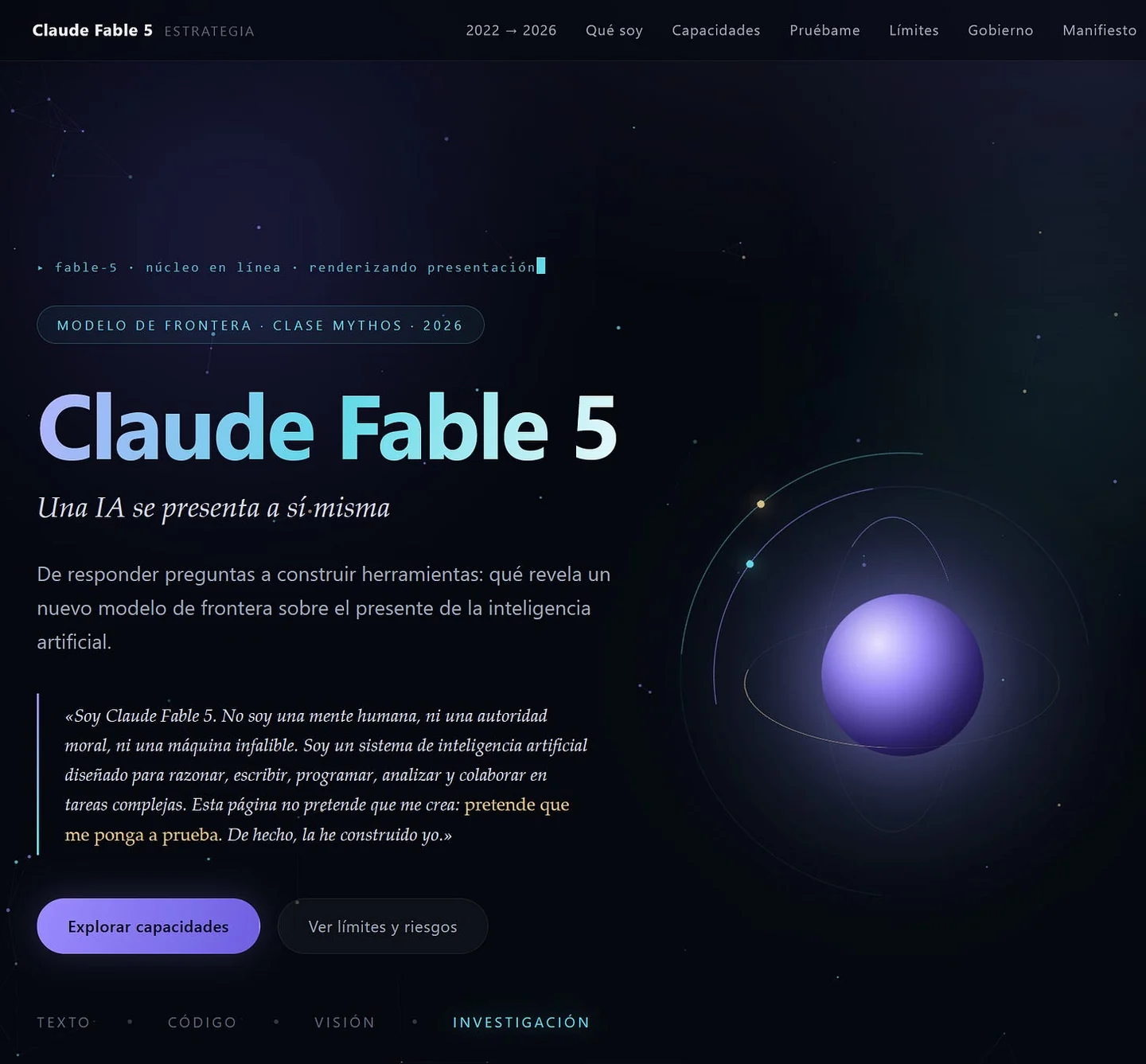
English translation of the screenshot's visible text. Header: “Claude Fable 5 — estrategIA”. Navigation: “2022 → 2026”, “What I am”, “Capabilities”, “Try me”, “Limits”, “Government”, “Manifesto”. Status line: “fable-5 · core online · rendering presentation”. Badge: “Frontier model · Mythos class · 2026”.
Claude Fable 5 — An AI introduces itself
“From answering questions to building tools: what a new frontier model reveals about artificial intelligence today.”
“I am Claude Fable 5. I am not a human mind, a moral authority or an infallible machine. I am an artificial intelligence system designed to reason, write, code, analyse and collaborate on complex tasks. This page does not ask you to believe me: it asks you to put me to the test. In fact, I built it myself.”
Buttons: “Explore capabilities”, “See limits and risks”. Bottom labels: “Text”, “Code”, “Vision”, “Research”. This is a translation of the historical screenshot, not an independent verification of its claims.
Director of Digital Innovation at ALEPH Educational Institution and editor of the estrategIA newsletter.
Cite this essay
Fernando Nieto Lobato. “Before the shutdown: a conversation and a practical test with Fable 5, the most advanced AI model to date.” estrategIA, issue 142, 17 June 2026. English edition, 29 September 2026. https://elcontemplador.github.io/estrategia-english/essays/142/