Regular readers of estrategIA will know that we have been following closely—both in these pages and through our lists on X and other channels—the emergence of initiatives that use artificial intelligence to scrutinise the public sector. A few days ago, technology analyst and Error500 founder Antonio Ortiz published an interesting article, Watchdogs of power with artificial intelligence, bringing together some of the most promising current examples. Reading it was the perfect prompt to explore this phenomenon in this week's estrategIA: one that has expanded rapidly in recent months as AI capabilities have advanced. The information imbalance between the state and the citizen has always had a quiet ally: opacity in practice. For years, public administrations have complied with the letter of the law by publishing millions of data points, often burying them in endless PDFs, impenetrable official bulletins or labyrinthine platforms.
The explosion of generative AI and the phenomenon of vibe coding—developing software by describing what you want it to do in ordinary language—which we discussed recently, are changing the rules. A citizen equipped with language models can now compress work that once took months into a few hours.
One point needs to be clear from the outset: these tools do not, by themselves, “prove” corruption. What they do is different, and perhaps more valuable: reduce the operational opacity of the state and quickly indicate where to look for possible offences or malpractice. AI is removing the friction that prevents public information from being genuinely open to scrutiny.
Data activism and civic scrutiny are hardly new. Over the past decade, we saw admirable civic tools emerge, from platforms for submitting freedom of information requests to projects that painstakingly extracted data—scraping—from official bulletins. But developing them required teams of programmers, months of work and extensive technical knowledge. The real shift introduced by AI is the dramatic lowering of the barrier to entry. What was once the preserve of civic hackers and experienced developers is now within reach of citizens with no formal computing background, who can build their own transparency projects simply by talking to a machine.
Spain's new civic wave
Spain's ecosystem offers the best example of this second generation of civic tools. Projects are flourishing, driven by individuals or very small teams who use generative AI to build in days what once took months:
-
Contratación Abierta: developed by engineer David Fernández, this platform allows users to scrutinise small-value public contracts awarded by thousands of public bodies. Its Red Flags Monitor applies more than 30 statistical analysis techniques to identify patterns that deserve closer examination, such as amounts suspiciously close to the legal threshold above which a contract must be put out to tender.
-
Menjòmetre: created by the anonymous collective Segell Fosc and developed entirely with AI. This observatory cross-references grants and contracts in Catalonia to produce a statistical index of concentration, recurrence and relative position. Its strength lies in methodological transparency: the team publishes its code openly and makes clear that its score reflects recurring statistical patterns, not a moral judgement.
-
Larenta.es: Pau March, a marketing professional without a conventional software development background, used AI tools to create an assistant that analyses more than 370 regional and national deductions from Spain's personal income tax, IRPF. In two minutes, it translates tax jargon into language citizens can understand.
-
From data to algorithms: we should not forget the groundwork that made this possible, led by outstanding individual campaigners such as Jaime Gómez-Obregón and pioneering organisations such as Civio. I can speak from experience here: I have been a supporting member for years. Last year, Civio secured a Supreme Court ruling recognising its right to access the source code of BOSCO, the software used to determine eligibility for Spain's social electricity discount. That milestone takes the debate into a new dimension: from data transparency to algorithmic transparency. If the state makes decisions through software, public scrutiny requires that code to be opened up.
Latin America: from the pioneers to generative AI
Latin America offers a fascinating perspective because it reveals the phenomenon's full lineage: from the major early projects that established its methods to the latest conversational tools.
-
The pioneers in journalism and civil society: before the ChatGPT boom, projects such as Operação Serenata de Amor in Brazil were already automating the detection of suspicious parliamentary expenses through their robot, Rosie. Along similar lines, the Funes algorithm, created by the Peruvian outlet OjoPúblico after 15 months of multidisciplinary development, established a methodological gold standard for cross-referencing databases and detecting risks of collusion. These are the giants on whose shoulders the new wave stands.
-
Living infrastructure: Brazil's ecosystem has also produced Querido Diário, which uses AI to centralise, open up and make searchable the official gazettes of thousands of municipalities. It is not the latest generative AI, but it tackles the fundamental bottleneck: turning unmanageable PDFs into structured data on which conversational models can subsequently operate.
-
The new AI-native generation: the shift towards agile, conversational tools is already visible. In March 2026, Argentina saw the launch of OpenArg, a platform with a multi-agent architecture that queries 32 public data portals in real time to answer citizens' questions with charts and direct sources.
-
Institutional automation: the Chilean state, meanwhile, shows that public administrations are taking notice too. ChileCompra has expanded automated monitoring to 100% of the procurement processes published on Mercado Público, applies 15 control rules and has already issued alerts about potential conflicts of interest. It has also announced plans to introduce language models during 2026 to review tender specifications, administrative decisions and technical annexes automatically.
Decentralising scrutiny
The lesson of this new wave of tools is clear: effective transparency is about making data intelligible, not simply publishing more of it.
The capacity for scrutiny is becoming radically decentralised. It no longer depends exclusively on large newsrooms, oversight bodies or specialist technical teams. We are no longer talking simply about cheaper software production, but about code ceasing to be a barrier to entry. With the frontier AI already in our hands, any ordinary citizen with no prior computing knowledge can sit down at a screen, describe an instance of opacity that angers them and build their own public scrutiny project from scratch.
In this new landscape, where the monopoly on civic oversight is breaking open in favour of ordinary people, the fundamental question is no longer simply whether society can hold power to account more effectively. The real challenge is whether democratic institutions themselves can absorb and respond to these civic capabilities without stripping them of independence, traceability and public control—and while developing initiatives of their own that rise to the same standard.
Director of Digital Innovation at Institución Educativa ALEPH and editor of estrategIA
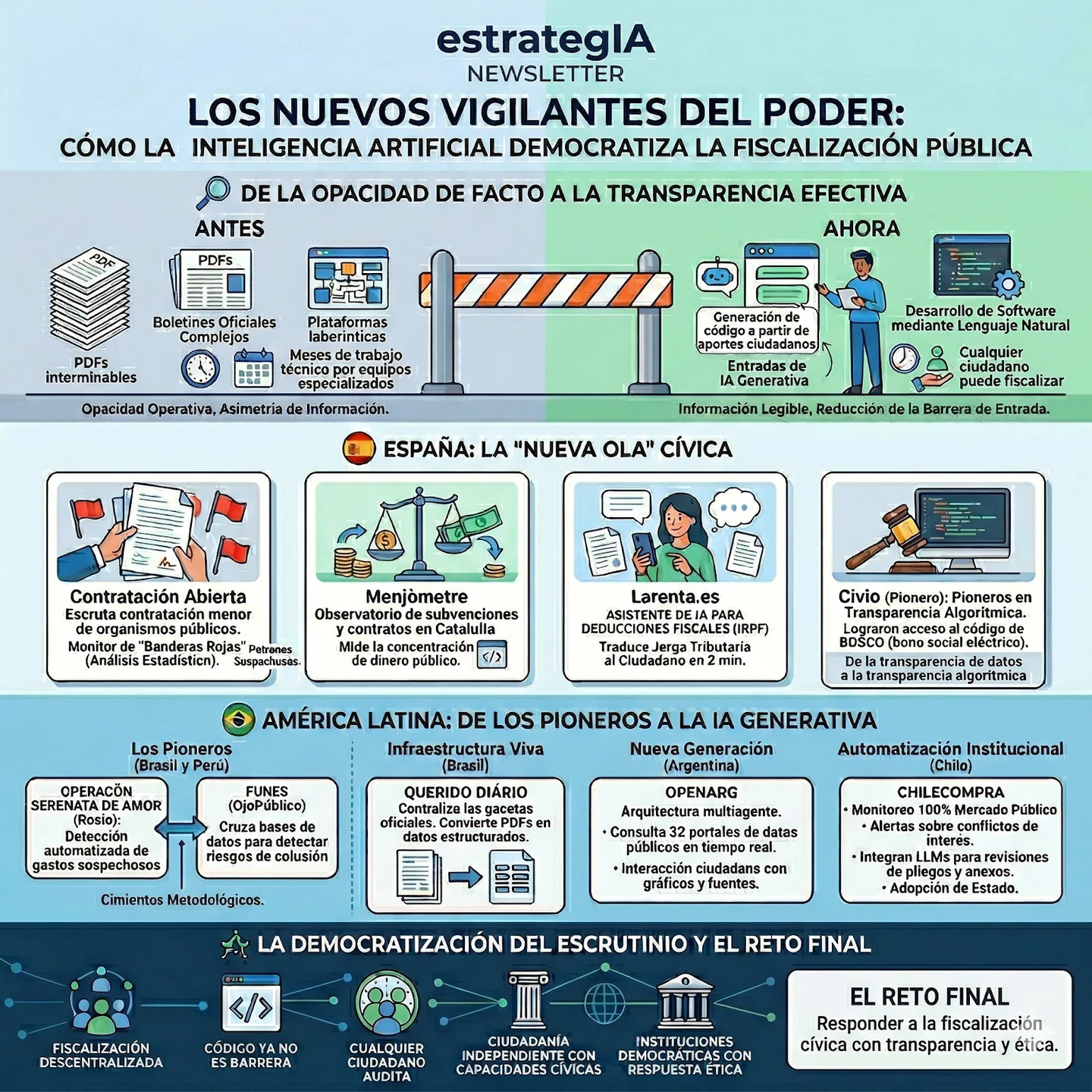
English text alternative for the infographic
estrategIA newsletter — The new watchdogs of power: how artificial intelligence democratises public scrutiny.
From opacity in practice to effective transparency
Scroll across the table to read all columns.
| Before | Now |
|---|---|
| Endless PDFs; complex official bulletins; labyrinthine platforms. | Code generated from citizens’ input; generative AI inputs. |
| Months of technical work by specialist teams. | Software development through natural language; any citizen can scrutinise public affairs. |
| Operational opacity and information asymmetry. | Intelligible information and a lower barrier to entry. |
Spain: the new civic wave
- Contratación Abierta. Scrutinises small-value contracts awarded by public bodies. A ‘Red Flags’ monitor uses statistical analysis to identify suspicious patterns.¹
- Menjòmetre. An observatory of grants and contracts in Catalonia. Measures the concentration of public money.
- Larenta.es. An AI assistant for tax deductions under Spain’s personal income tax, IRPF. Translates tax jargon into language citizens can understand in two minutes.
- Civio — a pioneer in algorithmic transparency. Secured access to the code of BOSCO, the system for the social electricity discount. From data transparency to algorithmic transparency.
Latin America: from the pioneers to generative AI
The pioneers — Brazil and Peru. Operação Serenata de Amor and its robot Rosie automate the detection of suspicious expenditure. Funes, from OjoPúblico, cross-references databases to detect risks of collusion. Together, they provide methodological foundations.¹
Living infrastructure — Brazil. Querido Diário centralises official gazettes and turns PDFs into structured data.
The new generation — Argentina. OpenArg uses a multi-agent architecture, queries 32 public data portals in real time and supports interaction with citizens through charts and sources.
Institutional automation — Chile. ChileCompra: monitoring of 100% of Mercado Público; alerts about conflicts of interest; integration of large language models for reviewing tender specifications and annexes; adoption by the state.²
Democratising scrutiny and the final challenge
The sequence at the bottom reads: decentralised scrutiny → code is no longer a barrier → any citizen can audit → independent citizens with civic capabilities → democratic institutions responding ethically.
The final challenge: respond to civic scrutiny with transparency and ethics.
Notes on the original graphic:
¹ Several labels in the Spanish image contain malformed words or names. The small ‘suspicious patterns’ label and the word for statistical analysis in the Contratación Abierta panel are garbled; their intended meaning is rendered here using the accompanying article. The graphic also misspells Catalonia, the name of Operação Serenata de Amor and Rosie, and the word for citizens in the OpenArg panel; it labels Chile ‘Chilo’. The English alternative uses the names and meanings established in the article. These are clarifications of the graphic, not new factual claims.
² The graphic presents the integration of language models as current. The article’s more precise account says that ChileCompra had announced plans to introduce them during 2026. That difference is retained and identified here; the graphic is not evidence that the planned deployment had already taken place.
Cite this essay
Fernando Nieto Lobato. “The new watchdogs of power: how AI is democratising public scrutiny.” estrategIA, issue 131, 1 April 2026. English edition, 29 September 2026. https://elcontemplador.github.io/estrategia-english/essays/131/