Archive note: this essay was published on 22 January 2025. Its forecasts and late editorial updates are preserved together, including the original’s references to a possible repeal of Biden’s executive order after a parenthetical update had already reported that repeal. The predictions are not an account of subsequent events.
The start of 2025 finds the United States at the beginning of Donald Trump’s second term. Yet the political and technological landscape has undergone a significant transformation since his previous administration, from 2017 to 2021. Artificial intelligence, a force that was then beginning to emerge, has become a driver of change with profound implications for the economy, national security and everyday life. Businesses, federal agencies, state governments and citizens now watch with a mixture of anticipation and caution to see how AI policy will take shape in this new period. Early signals point towards a thorough overhaul of the existing framework, with possible outcomes ranging from deregulation to encourage innovation to more intense competition with China for technological leadership.
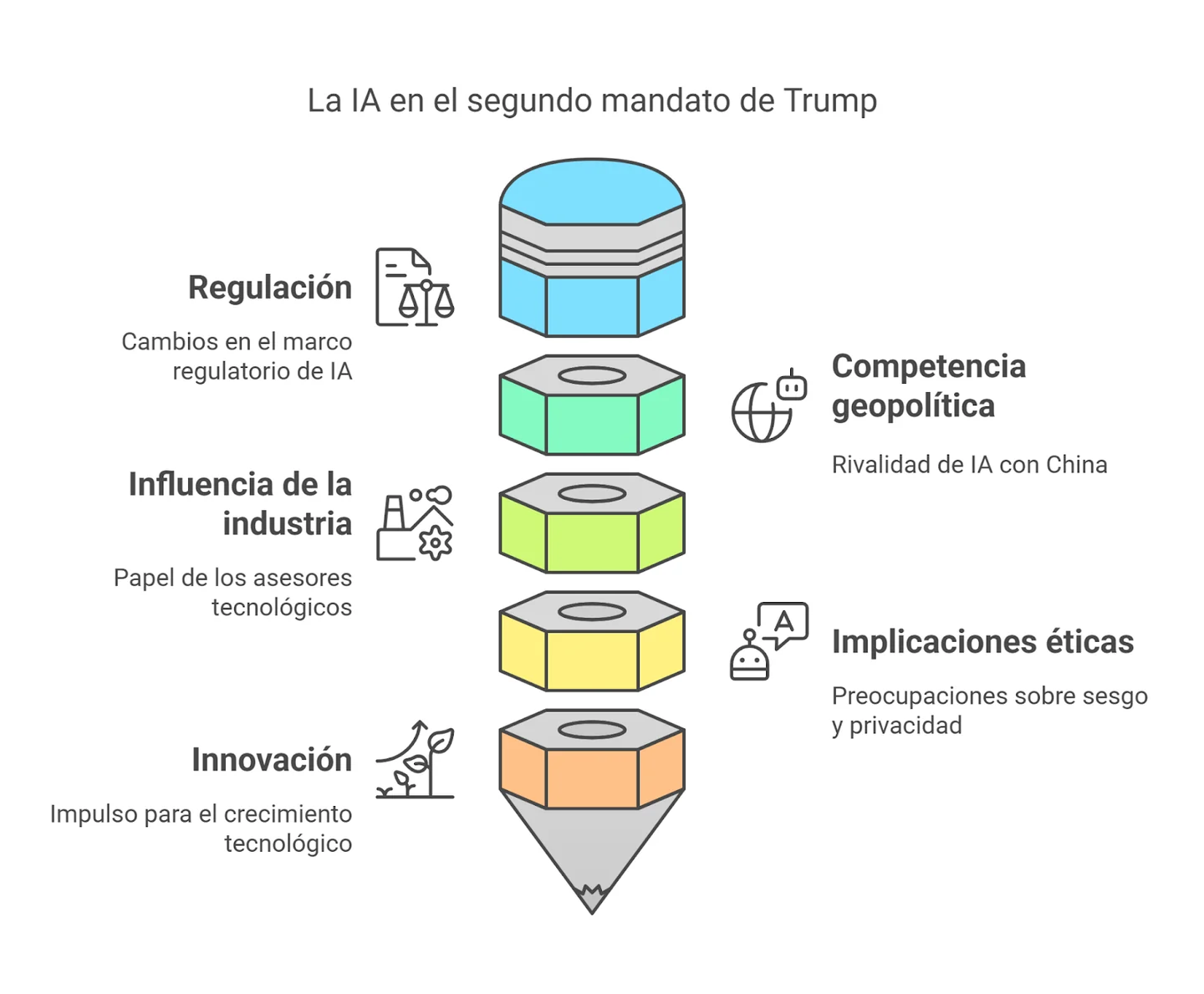
Original diagram, “AI in Trump’s second term”: regulation — changes to the AI regulatory framework; geopolitical competition — AI rivalry with China; industry influence — the role of technology advisers; ethical implications — concerns about bias and privacy; innovation — support for technological growth.
1. From dismantling to rebuilding: the future of regulation
One of the first decisions to set the direction will be the expected repeal of the executive order on AI signed by President Biden in 2023 (indeed, this happened after the article had been finalised). Conceived as a protective shield, the order sought to establish safeguards for civil rights and promote responsible AI development, with particular emphasis on preventing discriminatory bias and protecting the environment. The new administration, however, could see this regulatory approach as a burden.
Technology policy experts suggest that Trump’s compass could point towards greater deregulation, arguing that freeing businesses from “unnecessary obstacles” will encourage innovation and strengthen the United States’ competitive position, particularly in its vibrant start-up ecosystem. Imagine, for example, a small company developing innovative algorithms for medical diagnosis. Excessive regulation could entail costly validation and certification processes, delaying its entry into the market and limiting its ability to compete with established technology giants.
Yet the complete removal of regulation seems unlikely. Some analysts anticipate that, after revoking Biden’s order, the Trump administration could issue its own directive, focused primarily on AI applications in defence and cybersecurity. Cybersecurity, in particular, has become an invisible battlefield in which AI plays an increasingly crucial role in detecting and neutralising threats. An executive order focused on this area could encourage investment in defensive AI technologies and collaboration between the public and private sectors to protect critical infrastructure.
This possible shift nevertheless raises concerns about civil protections. Biden’s order included guidelines to mitigate biased uses of algorithms in areas such as recruitment and lending, seeking to ensure fairness and prevent discrimination. Several observers warn that a less regulatory approach could weaken these oversight mechanisms, leaving vulnerable populations exposed to automated decisions by potentially biased AI systems. Consider a facial-recognition system used by law enforcement that, because of deficiencies in its training, misidentifies people of certain ethnicities more frequently, leading to wrongful arrests and eroding trust in institutions.
2. The private sector at the helm and fragmentation between states
The distinctive feature of the US system of AI regulation is the absence of comprehensive federal legislation. Until now, state rules have led the way, creating a regulatory patchwork with different levels of stringency. This fragmentation could intensify if the federal administration chooses a laissez-faire approach, creating uncertainty for businesses operating nationwide.
Despite possible ideological differences, major technology companies agree on the need to work with government on AI. Businesses such as IBM, Cloudera and Lyssn have expressed their willingness to offer their expertise and knowledge. Trump’s preference for a less interventionist market, however, could translate into greater reliance on industry “self-regulation”, rather than strict oversight by federal agencies. This model would depend heavily on companies’ goodwill and ability to establish robust ethical and safety standards — something that has not always been a constant in the technology sector.
The absence of clear federal guidance could exacerbate competition between states. Those with looser rules could become magnets for AI investment, while those taking a more restrictive approach could become less attractive. This phenomenon has already been seen in states such as Florida and Texas attracting companies from California, a state known for stricter regulation in various areas. This “war of jurisdictions” could fragment the market and hinder the creation of a coherent national AI ecosystem.
In public procurement, businesses expect the federal government to streamline the acquisition of AI-based technology solutions. Modernising bureaucracy through AI tools could deliver significant efficiencies, but companies are calling for mechanisms that allow both large corporations and start-ups to compete on equal terms, avoiding excessively complex and bureaucratic tendering processes.
3. AI as a geopolitical battlefield: China’s shadow
Rivalry with China for AI leadership was a constant during Trump’s first term and is expected to intensify further. Restrictions on exports of advanced chips and pressure on allies to limit China’s access to key technologies were among the instruments used by his previous administration.
Trump is likely to maintain or even tighten these export controls, following the course initiated by his own administration and continued by Biden’s, which strengthened controls through legislation introduced in its final days in office. Access to cutting-edge semiconductors is vital to advanced AI development, and the United States seeks to limit China’s ability to compete in this strategic field.
Beyond restrictions, greater investment in military AI is anticipated. Several analysts suggest that Trump could encourage partnerships between the public sector and specialist defence companies, seeking to develop more autonomous intelligence systems capable of processing large volumes of data and strengthening cybersecurity. The idea of a “Manhattan Project” for AI — a major national initiative — could re-emerge as a way to accelerate technological development and avoid losing ground to China’s rapid advances.
The United States’ AI strategy cannot, however, ignore the international landscape. Its relationship with the European Union, a pioneer in AI regulation through its AI Act, will be crucial. Europe’s regulatory approach, stricter than the one anticipated in the United States, could generate friction and make regulatory harmonisation more difficult. The possibility that the EU will continue penalising US companies over competition or data-protection practices could put further strain on transatlantic relations.
4. The voices heard in the Oval Office: influence and advice
A distinctive feature of Trump’s new circle of advisers is the presence of prominent figures from the technology sector. Elon Musk’s appointment to co-lead a “Department of Government Efficiency” and the influence of investor Vivek Ramaswamy illustrate this trend. Both combine technological optimism with a preference for less state intervention.
Musk’s views on AI’s existential risks could influence the adoption of safety measures in the development of advanced models. Yet his advocacy of the “free market” and leadership of xAI, an AI company, raise questions about potential conflicts of interest when promoting regulations that might benefit his own projects.
Meanwhile, major technology companies appear to have adopted a less confrontational stance towards Trump. Companies including Apple, Amazon, Meta and Salesforce have sought closer relations, offering financial support and taking part in high-level meetings. Their aim is to ensure that new AI policies do not harm them, whether in antitrust matters or in defining copyright rules for training AI models on protected data. This “change of tone” suggests a pragmatic strategy by Big Tech to influence political decisions from within.
5. The ethical and social horizon: unresolved challenges
AI’s relentless advance poses increasingly urgent ethical and social challenges. Privacy, disinformation and potential labour-market disruption demand attention. The Biden administration had promoted initiatives such as the AI Bill of Rights and specific sections of its executive order to address algorithmic accountability.
There is bipartisan agreement on the need to prepare the workforce for AI-driven automation. Trump, with his pro-worker rhetoric, could promote training and retraining programmes. Yet the actual allocation of resources to these initiatives will be a key indicator of how seriously that commitment is taken.
Privacy and algorithmic bias pose significant risks. Without rigorous oversight, facial-recognition or predictive-analysis systems could perpetuate and exacerbate racial, socioeconomic or gender prejudice. The possible repeal of Biden’s order, which included mechanisms to mitigate these disparities, increases the risk of abuse and discrimination.
Finally, AI’s environmental impact cannot be ignored. The technological infrastructure needed for its development, particularly data centres, consumes enormous quantities of energy. While Trump’s previous administration prioritised fossil fuels, pressure to adopt renewable energy sources is growing. The appointment of figures with experience in the traditional energy industry suggests that data centres’ energy demand will be met, but it remains to be seen whether the approach will be sustainable or prioritise conventional sources.
A new chapter in the AI era
Donald Trump’s second term begins at a crucial moment for artificial intelligence. The possible repeal of Biden’s order and the adoption of a more deregulated, pro-business approach point towards a future with greater emphasis on competitiveness and innovation, but also mounting uncertainty over ethics, fairness and cybersecurity.
AI is emerging as a central axis of US policy in this decade, shaped by the tension between maintaining technological supremacy over China and the urgency of preserving democratic values and civil rights. The influence of figures such as Elon Musk adds an element of unpredictability, while major technology companies seek to navigate this new landscape and consolidate their positions.
The response of individual states and international actors such as the European Union, with its progress on AI regulation, could create a situation of regulatory competition that forces the Trump administration to balance economic pragmatism with some degree of global cooperation. Despite the unanswered questions, it is clear that AI’s development over the next four years — a period in which we could even see the arrival of artificial general intelligence (AGI) — will have profound geopolitical, economic and social repercussions, both in the United States and around the world.
Just hours before this newsletter was due to go out, Trump, alongside OpenAI CEO Sam Altman, SoftBank CEO Masayoshi Son and Oracle chairman Larry Ellison, unveiled the “Stargate” project, with $500 billion of investment in artificial intelligence infrastructure. Its scale recalls the Manhattan or Apollo projects, although as a share of GDP and in inflation-adjusted current dollars it is even larger than those initiatives, and demonstrates the United States’ determination to lead in AI.
Fernando Nieto Lobato
Director of Digital Innovation, Institución Educativa ALEPH
Selected principal sources used for the article
- “What Will AI Policy Look Like Under the Trump Administration?” — Julia Edinger, Government Technology.
- “AI Policy in Transition: Trump’s Second Term” — Angela Luna.
- “AI Under a Second Trump Administration — AI: The Washington Report” — Bruce D. Sokler et al.
- “How AI regulation could shake out in 2025” — Ryan Browne, CNBC.
- “What does Big Tech hope to gain from warming up to Trump?” — Associated Press.
Cite this essay
Fernando Nieto Lobato. “Artificial intelligence in the new Trump era: an analysis in five dimensions.” estrategIA, issue 069, 22 January 2025. English edition, 29 September 2026. https://elcontemplador.github.io/estrategia-english/essays/069/