Archive note: this article describes the editorial workflow in February 2025. Its statements about tools, models and the use of AI refer to that original workflow, including the author's statement that AI was not used directly to write this particular Spanish article.
A few weeks ago, in a conversation with estrategIA's editor, Pablo Martín, he suggested writing an article about how we put together each issue of this newsletter.
At first, I did not think this would be particularly interesting to you, dear readers. But after giving it more thought, I realised that an article like this could be useful if we approached it in the right way. Less as an account, however brief, of the complex system behind estrategIA and all the work it involves, and more as a way to offer practical insights in two potentially relevant areas. First, by sharing a selection of the best sources we consult every day to build this publication, which could help you learn more and explore the fascinating world of AI in greater depth. Second, we want to show you some of our workflows using different AI tools, which might give you ideas for applying them to similar processes in your own work or studies.
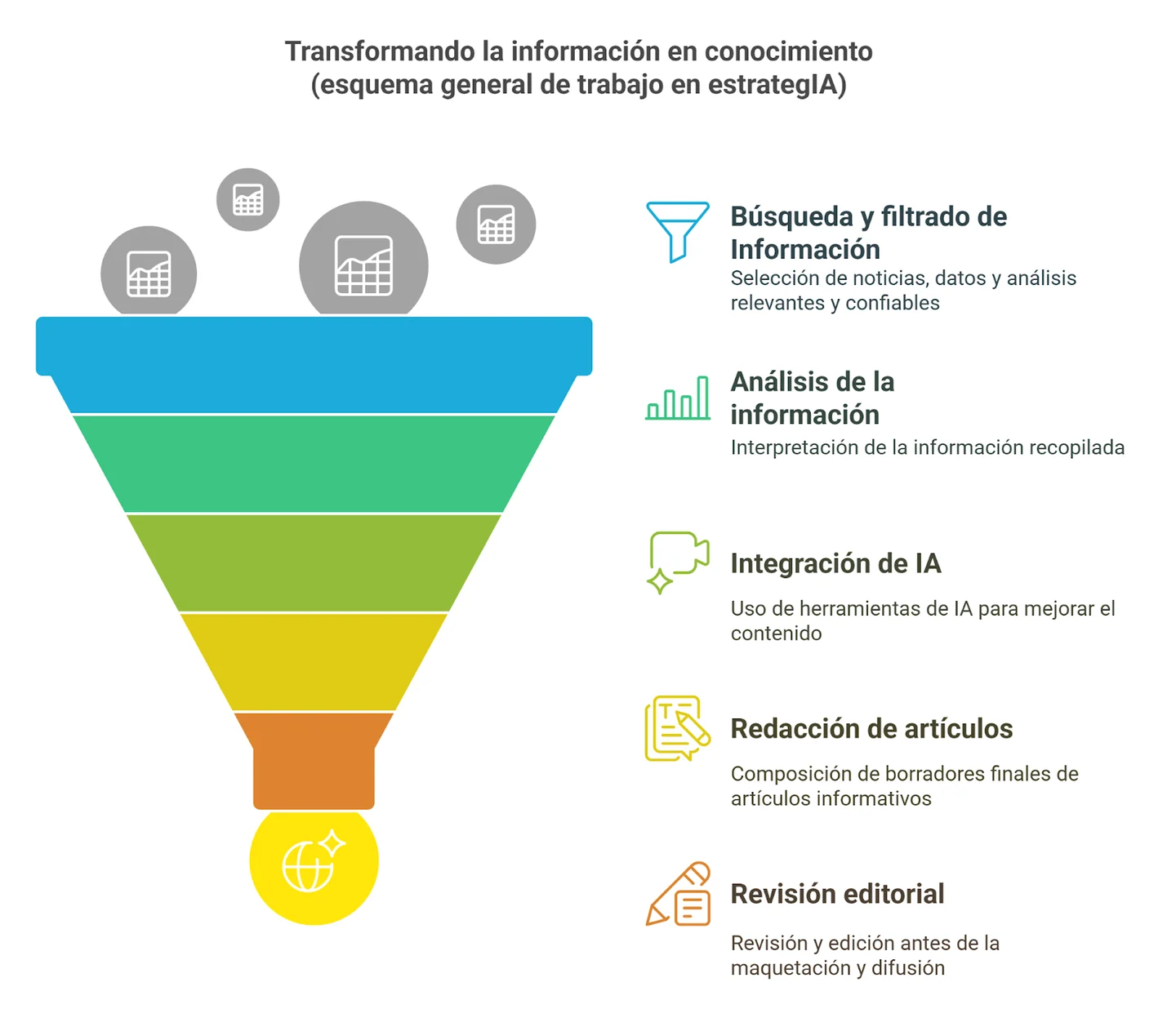
Text in the diagram — “Turning information into knowledge: an overview of the estrategIA workflow”:
- Finding and filtering information: selecting relevant, reliable news, data and analysis.
- Analysing information: interpreting the information collected.
- Integrating AI: using AI tools to improve the content.
- Writing articles: preparing final drafts of informative articles.
- Editorial review: reviewing and editing before layout and distribution.
With that aim in mind—both to describe the main processes behind estrategIA and to help you find interesting ideas and material you can put to use—we will take you through the three main stages of creating our newsletter.
1. Knowing what is happening in AI and selecting what is most interesting and relevant
The first requirement, the foundation of everything, for producing each issue of estrategIA is to be really well informed about what is happening in AI, particularly its application to politics and government. To that end, the person writing these lines spends at least two or three hours a day—usually at weekends too—reading, analysing and comparing information, chiefly from the following sources.
A. X, formerly Twitter
Over these past two years of following the explosion of generative AI very closely, I have gradually turned my personal Twitter account, @elcontemplador, into an enormously useful and valuable tool for keeping up with AI developments and releases, and the conversations around them.
That means following the CEOs of leading companies, researchers at the most advanced AI laboratories, prominent academics using AI in their fields, artists who are enthusiastic about AI… In my case, X's own recommendation algorithm does an excellent job in the “For you” tab, based on my previous interactions, so I can spend hours scrolling through interesting material. But to make it easier to get the greatest informational value from X on AI, I have created a list of nearly 300 Twitter accounts that are particularly worth following for AI news:
As individual recommendations, I would also suggest the following accounts as a sample of different kinds of interesting users on X, beyond the major CEO and company accounts.
Ethan Mollick: an outstanding example of an academic working on AI, whom we have discussed many times in the newsletter and who consistently shares relevant articles and research.
Kimmonismus: a clear example, from Europe—in this case Germany—of an account focused on following AI news minute by minute and offering quick reflections on it, with a profile that sometimes even comes close to that of an AI insider.
LudovicCreator: one example—there are many interesting accounts in this field—of the most notable creators of audiovisual content using AI. This is a particularly interesting category, offering a glimpse of what AI-generated images and audio make possible.
I occasionally receive valuable information from other networks too, such as Bluesky (here are some interesting AI starter packs). Some people share especially valuable information elsewhere, such as Ethan Mollick himself on LinkedIn, or Yann LeCun on Threads—which makes sense given his position at Meta, the owner of Threads. Nevertheless, within AI, X's predominance as the place to go is enormous, notwithstanding the profound changes to the social network since Elon Musk bought it. If you are not there, you miss a large part of the conversation.
B. Reddit
After X, Reddit is my main primary source for keeping up with AI.
It can sometimes offer more specialised information and more complex analysis of news and its implications.
Although my favourite Reddit community is Singularity, where very interesting questions often arise about the application of AI and its relationship with politics, government and humanity's future across many fields, I must also recommend the LocalLLaMA community, particularly for its practical focus. It is a fantastic place for anyone interested in learning to run AI models locally on their computer or mobile phone.

Translation of the notification: “Achievement unlocked! You have unlocked the “Professor of Content” achievement in the LocalLLaMA community. Take a look!” The screenshot shows a Reddit notification at 20:50; the phone's clock reads 21:02 on Thursday 30 January. Other interface labels are “Control”, “Media output”, “Notification settings” and “Clear”.
Another feature that makes Reddit especially interesting is the events that companies or individuals sometimes organise. For example, OpenAI quite often holds live question-and-answer sessions, or AMAs, with its senior executives and researchers on its Reddit channel to mark a particular launch or event.
For example, the latest was held for the launch of o3-mini, on Friday 31 January at 23:00 Spanish time. The time difference with the US West Coast, currently the epicentre of the big AI companies, means that following developments almost minute by minute also requires adjusting to sometimes inconvenient hours. It does, however, occasionally bring the pleasure of an unexpected surprise when you switch on your tablet or phone shortly after waking up.
C. Newsletters
Another key ingredient in staying well informed about AI's development and producing estrategIA is newsletters. There are many, although those focused on news—the majority—tend to repeat topics and approaches. If you follow X and Reddit closely, they are unlikely to provide much valuable new information. For someone who does not devote most of their life to this, however, they can be enormously valuable by distilling the essentials in a structured way, much as we try to do here.
Alongside news-focused newsletters, there are others, especially on Substack, by particularly interesting people in AI, such as former OpenAI policy researcher Miles Brundage or Gary Marcus, the best-known AGI “sceptic”. These are highly recommended reading for understanding the deeper context behind events.
Between daily and weekly newsletters, I consult more than 20 a week, the vast majority in English. Among those focused on news, I would particularly recommend these three:
- Paréntesis media: probably the best for a straightforward Spanish-language summary of the most important daily AI news.
- Ainews: almost the opposite. In English, a very detailed account of everything that has happened in AI that day, including X, Reddit, AI Discord communities…
- The Rundown: among English-language news bulletins, probably the one that offers some different approaches, as well as stories that are hard to find elsewhere.
D. Other sources
Besides X, Reddit and newsletters, at estrategIA we also use other channels to round out our intensive monitoring of AI developments, including Discord or Telegram groups and the websites of particular media outlets. These are mostly sources we consult occasionally, but others are integrated into our regular workflow:
- We use a tool as “traditional” as Google News, with Spanish searches for “política e IA”, “gobierno e IA” and “elecciones e IA”—politics and AI, government and AI, and elections and AI—to try to find interesting news in these specific fields. Stories of lesser prominence or with a more local focus may not appear in other sources; they help broaden a picture that, for obvious reasons, is heavily centred on AI in the United States.
- YouTube: we are fortunate to have excellent Spanish-speaking AI communicators, whose videos we have recommended many times in the newsletter, such as Carlos Santana, or DotCSV, Xavier Mitjana and Jon Hernández. I often watch them over breakfast or lunch, or have them on in the background while doing other tasks that do not require much concentration. I mainly watch these channels for a more audiovisual view of developments, already filtered through the perspectives of creators whom I know are also exceptionally attentive to everything that happens. YouTube also contains absolute gems, generally only in English, such as in-depth interviews with AI researchers or CEOs, or the one we bring you in this issue's “Recommendation of the week”: Andrej Karpathy's course on large language models.
- OpenAI Tasks: when OpenAI recently announced its “tasks” for ChatGPT, one function we adopted was a daily summary of the three leading AI stories. In truth, although it does perform the task, we have yet to find distinctive value in the system in terms of bringing us particularly relevant or different news content.
2. Creating and writing
At this stage, particularly for the main article, the situation differs greatly from week to week, depending very much on the article. For example, this one involves no direct use of AI in its creation or writing. Even when we use artificial intelligence intensively, as we sometimes do, there is clear manual involvement at the beginning: identifying the subject, considering approaches, selecting information… There is also substantial manual intervention at the end, through rewriting, review, editing and final proofreading by one or more people other than the writer.
With those premises in mind—unfortunately, it will still be some time, although perhaps less than many people think, before an AI can carry out the entire process of creating a complete estrategIA newsletter perfectly—some weeks do bring articles centred on specific events with extensive news coverage that allow us to follow workflows in which AI plays a substantial role. For example, for the recent article on Donald Trump and what we could expect for AI during his second term, we started with information selected through the systems described in the first section. As often happens, particularly with X or Reddit, we initially consume it on a phone or tablet. After trying more complex solutions such as Evernote, we now bring it into the workflow through a private Telegram group, where I share everything relevant I find so I can process it later on the PC.
Once we have that general foundation—perhaps two or three particularly notable articles, tweets or opinions on Reddit—in the specific case of Trump's new term we actively used Perplexity and ChatGPT's search system to find as many relevant articles as possible, including news, opinion pieces, newsletters and so on.
Working from the entire selection of information, which always runs to several dozen pages, we use an advanced reasoning model, generally the most powerful available—in that case o1, whereas today it might be o3-mini high—to create an initial, structured overview containing all the main information we consider valuable. We may already make some manual selections here, removing or adding material. Once we have that document, we generate one or more article drafts by asking another model to write a version “for the newsletter” based on that information and at the approximate length required, usually around 1,000 words. Recently, for articles like this based on information about an event, we have mainly used Google's new reasoning models, which you can access free in Google AI Studio. We find them very good at “creative” writing from information that has already been structured and reasoned through. Before those models, our favourites for this task were usually Claude: first Claude 2, then Sonnet when it came onto the market.
Once we have several drafts, we request changes through different prompts to bring the article into line with our perspective and needs: removing a section, for example, or focusing more on an aspect of the topic we consider more relevant. Sometimes, though not usually, we use ChatGPT's canvas function for editing. This produces a final draft ready for manual review and adjustment, the last writing stage, and then proofreading.
To add value to the articles, in many recent weeks we have also been generating infographics. Our current favourite tool for this is Napkin.ai, although Infography.in is interesting too.
As for images, we have generally created them with Midjourney. Despite its high price, it is still the model with the greatest artistic and “editorial” capabilities. That said, the most powerful Flux models are now tremendously capable, especially at generating realistic images. As you know, you can use them free through X or the Mistral tool we introduced last week.
For the news and articles of interest section, we have long used an in-house GPT proto-agent that gives us consistent summaries of similar length for the main stories we have found through all the sources described in section 1. We simply give it the text of the story we want to include, from whichever source we consider best—on particular occasions, more than one—and the GPT proto-agent does the rest, generally on the first attempt.
Within the practical corner, the most time-consuming task is choosing the tool of the week, because we test at least two or three every week. It is impossible to keep pace with new developments in AI, increasingly so as time goes on and the pace accelerates. To test models that can run locally, we generally use Ollama or LM Studio on a computer with a 2080 Ti. We do not feature this very often, because it involves more complex configuration requirements and sometimes calls for more powerful computers than the standard laptop many people own. If anyone at Nvidia reads this and would like to send us a 5090, for instance, we would be delighted to try it and test larger models locally—or perhaps someone at Apple could provide an M4 Max with 128 GB of RAM.
With prompts, we have adapted to the times. That kind of writing is no longer as consequential: models are becoming more intelligent and producing better responses without the very specific structures needed a few months ago. Indeed, reasoning models should be prompted with a completely different structure; this week's prompts section brings you OpenAI's new guidance on precisely that point. We now generally concentrate on prompts that offer interesting perspectives on the week's topic. Starting from the final, or nearly final, text of the main article, we ask AI models, especially ChatGPT, for multiple options. We choose the best and then run them through a proto-agent specialising in improving prompts—we still regularly use Prompt Master, although there are many options. Finally, we adjust them manually and test the results.
The recommendation of the week section has no particular AI process; it draws on all the material we come across through the sources discussed in the first section.
Finally, for memes, although we once managed to create them almost automatically with a meme-generator plugin for ChatGPT, disabling plugins has made part of the process necessarily manual again. This may be the only occasion on which progress in AI has made our work more complicated. We still use AI to generate multiple options from the week's topic, easily 15 or 20. We then choose our favourite, make adjustments and create the final meme manually, usually with Meme Generator.
3. Layout, sending and distribution
We will spend much less time on this section because we think it has less applicability for you. It is, of course, essential to getting the newsletter in front of your eyes, so we will describe it very briefly.
Once all the preceding processes and the final review, carried out very efficiently by Andrea Molina Morales, are complete, we move on to layout. This differs slightly between Substack and LinkedIn.
With the main article and news texts now final, we record the audio versions that appear on Substack. Occasionally, we use a text-to-speech system set up in Azure, but generally we use a simpler version based on a privately duplicated Hugging Face Space running Multilingual TTS (Edge TTS). In recent weeks, much more capable text-to-speech tools have been appearing; we hope to test them soon and introduce them in the tool-of-the-week section.
With the audio ready and the layout complete, estrategIA is sent out every Wednesday at around 12:45 Spanish time, with accompanying posts on Substack Notes and LinkedIn.
The next day, Thursday, it is shared on estrategIA's own social accounts, such as our Twitter account, @ALEPHestrategIA—although, for lack of time, it is currently used far more for listening and monitoring than for active posting—on the authors' accounts, and later on those of the ALEPH Educational Institution.
The most notable part of this stage is undoubtedly the creation of a video featuring our avatar, made with HeyGen technology. Here is last week's as an example:
Archive note: the local source does not retain the embedded example video or a link to it.
And that is this week's article. We hope you have enjoyed this walk through the process of creating estrategIA, discovered valuable new sources of complementary information, and found new AI processes that could add value to your projects.
Director of Digital Innovation at the ALEPH Educational Institution
Cite this essay
Fernando Nieto Lobato. “From information to shared knowledge: the process behind every issue of estrategIA.” estrategIA, issue 073, 19 February 2025. English edition, 29 September 2026. https://elcontemplador.github.io/estrategia-english/essays/073/