There are nights when a country looks in the mirror without meaning to. The 2026 Super Bowl, held on Sunday 8 February, was one of them. An audience approaching 125 million in the United States made the game an all-encompassing civic event: television, streaming, second screens and public conversation in real time. When a ritual concentrates national attention on that scale, what appears on stage is no longer simply sport or entertainment. It becomes a major cultural and political act.
Half-time as a political fault line
Bad Bunny's performance—his full name is Benito Antonio Martínez Ocasio—is very probably better known worldwide than the result itself: the Seattle Seahawks beat the New England Patriots 29–13. It worked as a political thesis expressed through pop culture: predominantly Spanish, with explicit references to Puerto Rico and an aesthetic asserting Latino identity as a constituent part of “America”, rather than a footnote. Media coverage also recorded Donald Trump's angry reaction and the organised clamour around an “alternative half-time” show promoted by Turning Point USA, with Kid Rock as its public face. The important detail is the mechanism. Cultural politics is moving into spaces with the largest audiences, where demography becomes spectacle and spectacle becomes a plebiscite.
Here is the twist: the same stage on which people passionately, and sometimes aggressively, debated what it means to “belong” was also used to introduce, without parliamentary debate, a vision of who should govern the new cognitive infrastructure: the artificial intelligence to come.
Advertisements as manifestos: when AI talks about values
In 2026, AI was not just another subject in the advertising breaks; it was one of their organising themes. We discussed AI advertising at the 2024 and 2025 Super Bowls in our recommendations in issue 20 and issue 72 of estrategIA. This time, however, the story went a step further, which is why it deserves a main article. According to the count cited by Adweek, 23% of Super Bowl advertisements incorporated AI in some form: product, narrative or creative production. With 30-second slots costing several million dollars—Reuters reported “up to $10 million”, the Wall Street Journal “more than $8 million”—advertisers were buying more than visibility. They were buying cultural legitimacy.
To make sense of the noise, we propose reading five commercials as miniature “digital constitutions”. Each defines a different relationship between person, machine and market, offering a small but revealing glimpse of what its company prioritises.
The great split: the battle for consumer trust, Anthropic versus OpenAI
OpenAI: OpenAI Super Bowl 2026 | Codex | You Can Just Build Things
Anthropic:
The most significant moment was the head-on clash between Anthropic and OpenAI. Not because this was the sector's first rivalry, but because it made explicit what friendly demos usually try to conceal: the business model. OpenAI focused its advertisement on Codex and the ability to create things with AI. Anthropic's campaign directly attacked OpenAI's announced plans to introduce advertising into conversational assistants, ending with a deliberately memorable slogan: “Ads are coming to AI, but not to Claude.” Sam Altman's public response, calling the advertisement misleading, matters less for the phrase itself than for what it acknowledges: the blow was moral, not technical.
The slogan and the Reuters and Wall Street Journal price quotations above are translated from the Spanish article; their original English wording has not been independently verified. The linked videos remain the original examples.
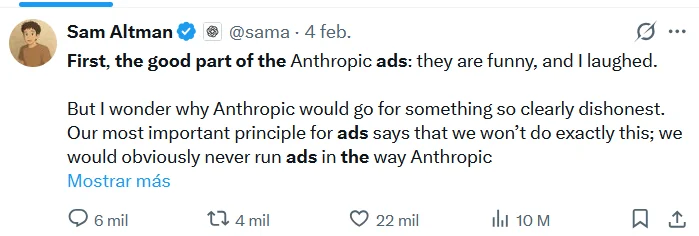
The visible portion of Sam Altman's original English post, dated 4 February, reads:
First, the good part of the Anthropic ads: they are funny, and I laughed.
But I wonder why Anthropic would go for something so clearly dishonest. Our most important principle for ads says that we won’t do exactly this; we would obviously never run ads in the way Anthropic
The screenshot stops at “Anthropic”, followed by “Show more”; the missing continuation has not been reconstructed. It displays approximately 6,000 replies, 4,000 reposts, 22,000 likes and 10 million views.
Beyond the important fact that OpenAI's planned advertising is not what Anthropic's commercials portray—at least initially—this opens up a fork with clear political implications and genuinely different visions:
- AI as a “sanctuary”, Anthropic: more private, more expensive, sold as an adviser with a fiduciary role and no advertising incentives.
- AI as a “public square”, OpenAI: mass-market, creative and accessible, but mediated by the attention economy.
In other words, this is more than a product battle. It is a struggle to define what “trust” means in the age of assistants.
Taming fear: Alexa+ and humour as politics
Big Game Commercial | Alexaaaa+ (Extended Cut)
Amazon's commercial with Chris Hemsworth and Elsa Pataky is a case study. It exaggerates a contemporary fear—“AI wants to replace me, control me, kill me”, very much in the spirit of the Simpsons episode discussed in last week's estrategIA—and turns it into a domestic joke. Then, with a touch of practical tenderness, it offers the solution: AI is “good” because it organises your life. The subtext is uncomfortable but useful. Assistants become normal not through explanations of models, but by lowering emotional defences which, at this point, are very probably exaggerated.
Meanwhile, Microsoft and Meta advance adoption through two classic channels of power: bureaucracy and bodily extension. Copilot promises that the world will become manageable if you put it through a spreadsheet. The glasses, with Oakley as their cultural vehicle, suggest that technology “disappears” when integrated into the body: first as a camera, then as a cognitive layer.
Microsoft 365 Copilot 2026 Super Bowl LX Advertisement - Simplifying Data
Oakley Meta | Athletic Intelligence is Here
Conclusion: culture is the new defensive moat
Taken together, the evening offers a reading that is both simple and demanding: technological adoption is turning into cultural integration. That is why the advertising breaks revealed more about the AI to come—at least mass-market AI—than many technical debates. They showed companies competing for a symbolic monopoly over concepts such as “safe”, “useful”, “honest” and “emancipating”.
Benchmarks alone cannot tell us AI's political impact. We must read its advertising as political theory in miniature: who is the ideal subject; which incentives become normal—advertising, subscriptions, dependency; and which invisible costs are accepted—data, attention, the capture of behaviour? Whoever wins that narrative, even using familiar electoral tactics such as negative campaigning, and makes their model of the world seem “natural”, will do more than sell more products. They will, in practice, write part of the digital social contract in the AI era we are only beginning to enter.
Director of Digital Innovation at ALEPH Educational Institution and editor of estrategIA.
Cite this essay
Fernando Nieto Lobato. “Super Bowl LX: half-time as a fault line between political assertion and the AI war.” estrategIA, issue 125, 18 February 2026. English edition, 29 September 2026. https://elcontemplador.github.io/estrategia-english/essays/125/