In this edition of estrategIA, we welcome a special contribution from consultant Fernando Ujaldón, who introduces the interesting case of Singapore’s transformation.
On the global artificial intelligence stage, Singapore is emerging as a clear reference point for innovation and strategic vision. With a population only just above five million, this small state between Malaysia and Indonesia has drawn up an ambitious roadmap balancing citizen protection with encouragement for innovation. At the heart of this strategy is meticulous preparation of its citizens for the AI era, setting a precedent for the rest of the world.
The country has achieved a striking economic and technological transition, raising its GDP per capita above even that of powers such as the United States. Driven by a strategy of continuous innovation, this growth has attracted technology giants and positioned Singapore as a magnet for the industry. Now, in a new chapter of its evolution, the country is preparing to embrace the AI era fully.
At the intersection of AI and governance, Singapore embodies a model of strategic foresight and adaptability. With a sharp focus on improving services for citizens and optimising administrative processes, its government has adopted AI as a catalyst for efficiency and innovation. Through AI-driven analysis, Singapore has streamlined policymaking, enabling evidence-based decisions and proactive intervention strategies. This paradigm shift towards data-driven governance, as numerous international observers emphasise, is a tangible example of using AI for social good.

Image: Singapore Government Agency Website.
A robust strategy based on leadership and regulation
In 2019, Singapore presented its first National AI Strategy, setting out plans to deepen AI use across different sectors of the economy. Since then, the country has seen significant advances in AI, with approximately 150 research and development teams established, alongside 900 start-ups exploring new applications and opportunities in the field. The National AI Strategy’s success depends heavily on collaboration between citizens, businesses, researchers and government.
The year 2023 marked another important milestone with the launch of National AI Strategy 2.0, or NAIS 2.0. It focuses on three key shifts from the initial strategy: moving from seeing AI as an opportunity to recognising it as a necessity; adopting a global perspective from the outset; and moving from individual projects to integrated systems.
To achieve these objectives, Singapore has identified ten key enablers, shown in the image, covering areas such as technological infrastructure, training and international collaboration. These will support AI implementation across practical applications ranging from healthcare to smart urban management.
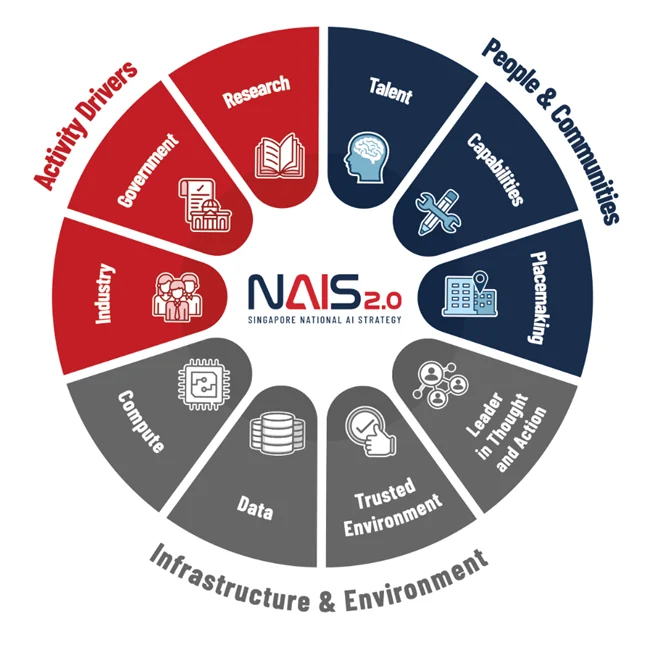
Image: Singapore Government Agency Website. Accessible transcription of the ten enablers:
Scroll across the table to read all columns.
| Group | Enablers |
|---|---|
| Activity Drivers | Industry; Government; Research |
| People & Communities | Talent; Capabilities; Placemaking |
| Infrastructure & Environment | Compute; Data; Trusted Environment; Leader in Thought and Action |
Initiatives such as “Trailblazers” have been a cornerstone of this vision, encouraging public–private collaboration to develop AI solutions. Launched in July 2023, the project’s main aim is to catalyse innovation by helping local companies identify and solve problems using AI. In partnership with Google Cloud and other key organisations, Singapore has brought more than a hundred AI projects to life, tackling a broad range of challenges in sectors such as health, transport and education.
Social impact: empowering communities through AI
Beyond government and the centres of power, AI adoption in Singapore extends into the fabric of society, catalysing transformative change in many areas. From health to transport and from education to urban planning, AI is reshaping everyday life in Singapore. Drawing inspiration from AI 2041, which imagines a world shaped by AI-driven innovation, the country is determined to lay the foundations for a future in which technology enables equitable growth and inclusive development.
Among its many notable projects, the following illustrate how Singapore is using AI for its citizens’ well-being:
SELENA+: an advance in AI-assisted medical diagnosis
This software system uses deep learning techniques to detect eye conditions with unprecedented accuracy. With SELENA+, doctors can identify eye diseases quickly and accurately, enabling earlier diagnosis and more effective treatment for patients.
More information about SELENA+
Project Pensieve: tackling dementia with advanced technology
This platform uses AI algorithms to detect early signs of dementia by analysing cognitive and behavioural patterns. By identifying key indicators, Pensieve enables early interventions that can delay the disease’s progression and improve quality of life for patients and their families.
More information about Pensieve
OneService: transforming municipal service management
This initiative is part of Singapore’s commitment to improving urban life through AI. An intelligent chatbot guides citizens in dealing with municipal services, from rubbish collection to infrastructure repairs. AI simplifies and optimises processes, ensuring a faster, more efficient response to the community’s needs.
More information about OneService
Investing in human capital to prepare citizens
Another striking feature of Singapore’s strategy is its emphasis on training and preparing its workforce for the AI era. Recognising the need for adaptation and reskilling or self-directed learning, Singapore has launched innovative programmes, including an initiative subsidising study for people over 40. This proactive approach not only ensures the continued relevance of Singaporean professionals but also strengthens the country’s global competitiveness.
SkillsFuture offers a broad range of courses and training programmes in different fields, from technical skills to soft skills such as leadership and communication. These courses are designed to meet the needs of people of all ages and experience levels, including those seeking new skills or a change of career.
A notable feature of SkillsFuture is the financial support it offers Singaporean citizens. Through subsidies and scholarships, the government covers a significant share of tuition costs for eligible courses, making training more accessible to everyone, regardless of their financial circumstances.
More information about SkillsFuture
This interesting video on Twitter, which went viral, including in several Reddit communities, shows MP Tan Wu Meng explaining the programme during Singapore’s budget debate, placing it in the context of the AI revolution. It showed the world that a country was already taking concrete action to adapt to the revolution artificial intelligence is bringing.
Practices and lessons from a global perspective
Within the wider story of AI in Singapore, certain practices and strategic insights emerge as reference points and guides for professionals and policymakers worldwide. By embracing a culture of experimentation and iterative learning, Singapore has encouraged an ecosystem conducive to innovation and risk-taking. Through strategic partnerships between government, academia and industry, the country has unlocked synergies that fuel AI-driven advances and sustainable growth.
Singapore’s leadership in AI adoption and regulation has not gone unnoticed internationally. While other countries are also stepping up their efforts, Singapore demonstrates a balanced approach and a long-term vision. As it moves towards an AI-driven economy, it is positioning itself as a model for nations seeking to embrace the technology’s transformative potential.
The road ahead
Singapore’s commitment to AI extends beyond the present. The recent publication of National AI Strategy 2.0 demonstrates its determination to remain at the forefront of the technological revolution. This new phase emphasises building a smart nation in which AI drives efficiency and innovation throughout society. By creating AI Centres of Excellence, strengthening government competence and increasing computing power, Singapore is laying the foundations for an AI-driven future.
It is also clear that exciting challenges and opportunities are emerging as Singapore progresses towards fully integrating AI into society. Safeguarding ethical values and ensuring equitable access to technology are becoming increasingly pressing. Yet with its pragmatic approach and intended commitment to excellence, Singapore continues to show its resolve to face these challenges with determination and foresight. Its roadmap invites the world to reflect on AI’s role in modern society, remembering that its transformative potential should be viewed with both optimism and caution.
Consultant. Technology Director at OmnicomPR Group Spain.
Cite this essay
Fernando Ujaldón. “Singapore: shaping the future in the light of artificial intelligence.” estrategIA, issue 026, 27 March 2024. English edition, 29 September 2026. https://elcontemplador.github.io/estrategia-english/essays/026/