Editorial introduction: this week’s main article is by Gabriela Ortega Jarrín, who holds a doctorate in Communication and is a political consultant specialising in election campaigns and public institutions’ communications, a brand management specialist, and Director of Strategy at ALEPH Educational Institution. Gabriela gives us her first-hand account of the special event Google held in Madrid to follow up on I/O 2025, which we covered in last week’s newsletter.
Historical context: this report was published on 4 June 2025 and retains the announcements, projections and regulatory framing of that time. Quotations below are translated from the preserved Spanish article.
English text: “Google Cloud Summit”, “22 May 2025”, “Madrid”.
First impressions count. When we arrived at Google Cloud Summit 2025, thousands of professionals were waiting to enter Hall 12 at IFEMA to explore Google’s latest innovations and their real-world applications. Inside, we found a futuristic, stadium-like stage which, after the opening talks and presentations of the company’s new services and products, became six simultaneous stages. Six talks ran at once, and through headphones you chose the colour of the room and the speaker you wanted to hear, presenting real cases of Google solutions in use. As though we were in a film set in the future, we were all at the same conference, all listening closely to a speaker. None of the attendees were talking to one another; only non-verbal communication conveyed how impressive some applications were, or sought a knowing response from colleagues, as if to ask: what if we did this in our company or organisation?
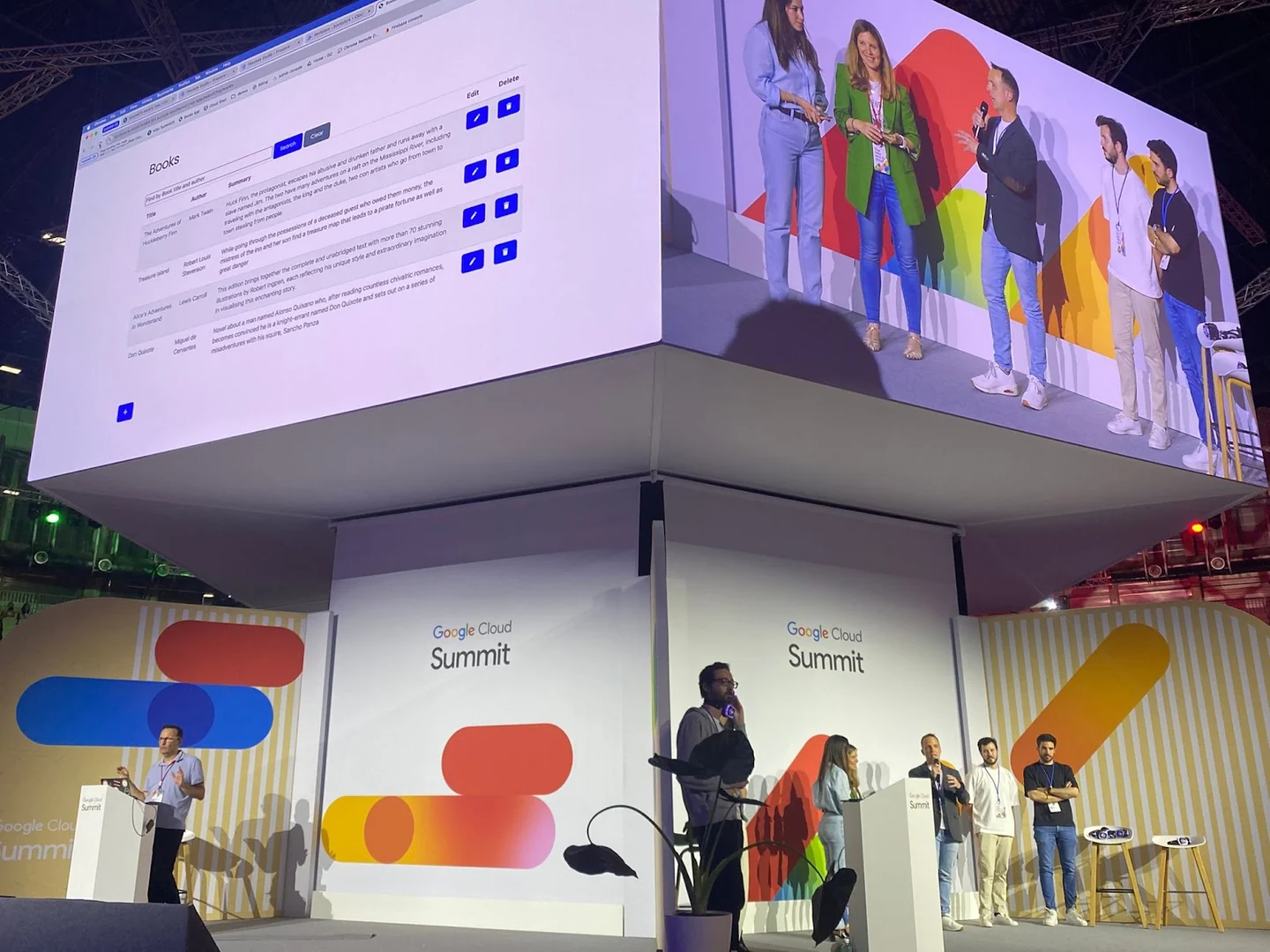
Visible demonstration text, already in English: “Books”; “Find by book title and author”; “Search”; “Clear”; columns “Title”, “Author”, “Summary”, “Edit”, “Delete”, and an add button marked “+”. The four entries shown are:
- The Adventures of Huckleberry Finn — Mark Twain. “Huck Finn, the protagonist, escapes his abusive and drunken father and runs away with a slave named Jim. The two have many adventures on a raft on the Mississippi River, including traveling with the antagonists, the king and the duke, two con artists who go from town to town stealing from people.”
- Treasure Island — Robert Louis Stevenson. “While going through the possessions of a deceased guest who owed them money, the mistress of the inn and her son find a treasure map that leads to a pirate fortune as well as great danger.”
- Alice’s Adventures in Wonderland — Lewis Carroll. “This edition brings together the complete and unabridged text with more than 70 stunning illustrations by Robert Ingpen, each reflecting his unique style and extraordinary imagination in visualising this enchanting story.”
- Don Quixote — Miguel de Cervantes. “Novel about a man named Alonso Quijano who, after reading countless chivalric romances, becomes convinced he is a knight-errant named Don Quixote and sets out on a series of misadventures with his squire, Sancho Panza.”
Generative AI serving the public sector: savings, efficiency and new roles
Below, we summarise the main developments presented for the public sector. If one thing is certain, it is that public administration and its relationship with citizens are being redefined. Perhaps we already knew that; now let us see how.
Efficiency and quality in the public sector through the automation of repetitive tasks
First, the technologies presented promise a substantial improvement in the efficiency and quality of public services. Esade and Implement presented a report on AI’s impact on Spain’s public sector, whose conclusions quantify a saving of 9% of each public employee’s time through the automation of repetitive tasks, translating into around €7 billion in annual added value. In addition, civil servants could shift towards higher-value functions, such as personalised assistance for citizens, strategic policy analysis and so on. Cumbersome bureaucratic processes could be streamlined with natural-language tools that draft reports or summarise case files in seconds. As the study notes, implementing AI strategically would make it possible to “optimise operations, improve decision-making and ultimately deliver better services to citizens more efficiently”. Some institutional caution still prevails, however: almost 60% of respondents feel their organisations are not fully prepared to integrate AI into their operations. In other words, there is optimism about AI’s transformative potential — three in four anticipate a positive impact — but also awareness of the remaining challenges in training, regulation and technological adaptation.
Digital sovereignty and data security: the response from Google Cloud and its partners
Digital sovereignty in the cloud and data security were prominent themes at the Summit, especially relevant to governments and regulated sectors in Europe. This allows public administrations to benefit from the cloud’s scalability and resilience without surrendering control over sensitive data. It is crucial in critical fields such as emergency services, defence, taxation and healthcare, among other sectors handling information that requires the strongest safeguards. Google Cloud reinforced its commitment to sovereign cloud: cloud services that guarantee local control of data and strict regulatory compliance. Notable offerings include Google Cloud Data Boundary, which can restrict the exact location of data and provides advanced key-management controls; Google Cloud Dedicated, cloud environments operated by local partners and adapted to specific sovereign requirements, already operating in France and coming soon to Germany; and Google Cloud Air-Gapped, a completely isolated cloud designed for highly sensitive sectors.
On security and compliance, one concrete example presented at the Summit was the Canary Islands’ 112 emergency service project. The Canary Islands Emergency and Security Coordination Centre, 112 — CECOES, is migrating the management of its critical data to a sovereign public-cloud solution provided by Google Cloud in collaboration with Minsait Cyber, Indra’s cybersecurity subsidiary, and the GuardedBox platform. This makes the Canary Islands’ 112 service one of Spain’s first public administrations to use the public cloud for critical services under an advanced sovereignty framework. The solution guarantees that sensitive data is stored and managed entirely within national territory, with fully auditable encryption and access controls. “For a service like ours, it is essential to have real control over our data, among the most sensitive and critical for citizens […] to know how and where the data is stored and protected,” explained Carlos García, the 112 service’s head of IT.
Many public institutions still use older systems and operate infrastructure locally rather than in the cloud, making cloud solutions or advanced AI harder to adopt. Technological modernisation requires sustained investment and updates not only to equipment but also to data architectures suitable for training and hosting AI models. Security, although strengthened in the cloud, remains a constant concern, since trust must be built between administrations and cloud providers. Pilot experiences such as the Canary Islands project demonstrate that a model replicable by other public bodies is possible.
The availability of local cloud regions — Madrid has hosted a Google Cloud region since 2022, the first from a hyperscaler in Spain — and trusted national partners such as Minsait and Telefónica Tech makes it easier for more public data to migrate to certified cloud environments. Public administration could thereby gain business continuity, with round-the-clock data centres and disaster recovery, and greater agility in deploying new digital services, without compromising sovereignty over its data.
AI to break down language barriers, and writing assistants to improve communication and productivity in organisations
Another central theme was the improvement in communication and productivity achieved through AI in Google’s platforms. Google Meet, its videoconferencing tool, deserves particular mention for adding AI features intended to break down language barriers and improve communication. A new real-time speech translation feature for meetings was announced: the speaker’s voice is automatically translated into the listener’s preferred language while retaining its original tone and timbre. This AI simultaneous translation debuted in beta for users of certain Google One plans, AI Pro and Ultra, in languages such as English, Spanish, French, Italian and Portuguese, with plans to extend it soon to business uses. Meet also demonstrated automatic AI-generated meeting summaries. At the end of a video call, the platform can provide a written summary of the main points discussed, agreed actions and next steps, all produced through natural-language processing.
For example, simultaneous translation in videoconferences and automatic transcription and summaries can facilitate collaboration between international bodies or different autonomous communities with co-official languages. They could also improve accessibility: imagine local council meetings or government webinars subtitled and translated live to reach a wider audience. Tools such as writing assistants in Gmail and Docs could help spokespeople and public communicators produce clearer messages, or help managers draft quick but carefully worded replies to citizens. Together, these generative AI communication capabilities can strengthen both internal coordination within the state and external communication with citizens, making them more inclusive and efficient.
Talent, regulation and multicloud competition: Europe’s new playing field
Google Cloud accompanied its technological announcements with institutional initiatives to prepare for responsible AI adoption. One of its most notable commitments concerned training and digital skills: the company announced a target of training one million people in Spain in cloud and AI skills by 2027. For ALEPH Educational Institution, taking part also offers an opportunity to turn training into practice and demonstrate improvements from applying AI in government and politics. We are therefore already working on a collaboration with Google Cloud. We will share further news… Other institutions involved include ASTIC, the body of public-sector ICT professionals, whose members will have access to Google Cloud Skills Boost resources and official certifications. Training programmes in AI are also being extended to teachers through Google for Education and to healthcare personnel in collaboration with professional associations such as ANDE and SEMERGEN.
Google.org, Google’s philanthropic arm, also awarded a $1 million grant to Fundación General CSIC to support open-source AI projects for scientific and healthcare purposes, from virtual-reality avatars for cerebral palsy therapies to drug-discovery software for neglected tropical diseases.
On regulation, Spain has positioned itself as a pioneering country by launching the first AI regulatory sandbox in line with the EU AI Act. This sandbox, a controlled testing environment, seeks to help start-ups and organisations develop and implement high-risk AI systems while meeting demanding European regulatory requirements. Google Cloud announced its active participation as a collaborator, providing a secure environment in its cloud alongside a toolkit for responsible AI. Specifically, Google will give the sandbox access to advanced capabilities such as Vertex AI, its platform for developing and managing models, and confidential computing services, enabling developers to test algorithms under conditions of maximum security and privacy.
The sandbox’s ultimate goal is to balance AI innovation and regulation. Spain is thus serving as a testing ground for two purposes: supporting responsible AI innovation, accelerating projects with potential positive social impact; and refining the practical rules that will guide the application of future European AI legislation. For Google Cloud, participation is also an opportunity to make concrete improvements to its own AI governance tools and develop a distinctive “responsible” cloud offering aligned with Spain’s demands for digital sovereignty.
In the same vein, regulation and the ethical use of generative AI raise questions about accountability, transparency and potential bias in automated decisions. Integrating AI into administrative processes, whether to propose draft decisions or prioritise cases, will require clear limits and human oversight. The EU AI Act will impose obligations, especially where “high-risk” systems are used in areas such as justice or employment. Participation in the regulatory sandbox is an advantage for Spain, enabling regulators and developers to learn together and adjust requirements before the law is widely applied. Practical questions remain, however: how can complex algorithms be audited? How can we ensure models used by a public administration meet criteria for non-discrimination, explainability and data protection? Institutions will need to create AI ethics committees, algorithm validation protocols and guidance for civil servants on responsible use. Meanwhile, compliance with rules such as the GDPR must continue to be guaranteed when personal data is used in models. Hence the importance of tools such as Data Boundary and confidential computing, presented by Google, which provide technical controls to support that compliance.
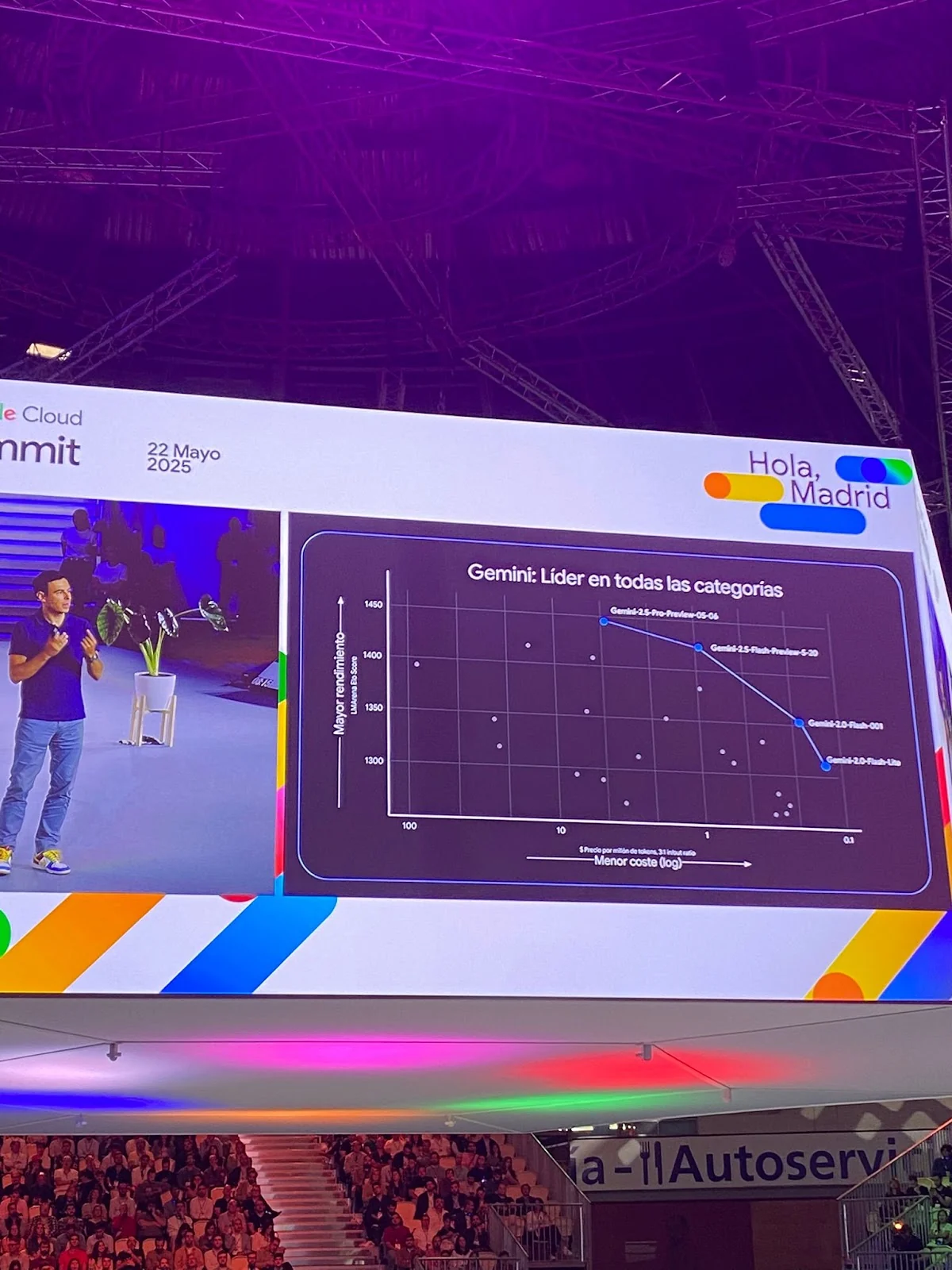
English text of the photographed slide: “Gemini: leader in all categories”. The vertical axis is “Higher performance — LMArena Elo Score”, with labelled ticks at 1,300, 1,350, 1,400 and 1,450. The horizontal axis is “Lower cost (log)”, running from 100 through 10 and 1 to 0.1; its measure is “$ price per million tokens, 3:1 input:output”. Blue points connected by a line are labelled Gemini-2.5-Pro-Preview-05-06, Gemini-2.5-Flash-Preview-5-20, Gemini-2.0-Flash-001 and Gemini-2.0-Flash-Lite, in that order from higher performance/higher cost to lower performance/lower cost. Other comparison points are unlabelled. Exact coordinates are not printed, so none are supplied here. The surrounding banner reads “22 May 2025” and “Hello, Madrid”.
The announcements at Summit Madrid 2025 paint an ambitious picture of what we may see: public administrations enhanced by generative AI, operating in secure sovereign clouds, with civil servants trained in new digital skills. Yet Google Cloud is one part of an ecosystem that includes other major players, notably global hyperscalers AWS, Amazon Web Services, and Microsoft Azure, all competing for the trust of European businesses and governments. Google Cloud Summit 2025 was therefore more than a product showcase: it was also a strategic positioning of Google in Europe’s digital ecosystem. Competition is intense, and Google Cloud seems determined to distinguish itself by placing AI at the centre of its value proposition. As Isaac Hernández, Director of Google Cloud Iberia, put it, “AI has changed everything all over again”, and Google takes a different approach from its rivals thanks to its own “integrated stack”, spanning specialised chips and advanced AI models. In particular, Google champions its Gemini model, claiming that version 2.5, presented globally, “is above any” alternative model in performance and cost. The company maintains that its latest TPU chip generations enable low-cost AI, with Gemini up to “seven times cheaper” than equivalent competing models. Google also stresses that it is the only cloud provider currently offering large AI models in every modality — text, image, audio and video — within its platform, giving it a very comprehensive catalogue.
Its competitors are not standing still, however, and are also adapting their strategies to Europe. AWS, for example, has announced plans for a “European sovereign cloud” separate from its global regions, designed specifically for public-sector and highly regulated customers in Europe. This AWS sovereign cloud will operate independently, with data centres solely in the EU — the first region is due in Germany at the end of 2025 — and incorporate controls to meet European regulators’ requirements for data residency and operational autonomy. Microsoft, meanwhile, presented its Microsoft Cloud for Sovereignty initiative in 2022: a public-cloud offering for governments and public administrations promising greater control, transparency and regulatory compliance. To develop it, Microsoft partnered with European companies, including defence firm Leonardo in Italy and Proximus in Belgium, to ensure local trust, and explicitly acknowledged that the move “intensifies competition” with AWS and Google in public-sector cloud services. European players are also making moves: consortia and local providers are promoting initiatives such as GAIA-X, a framework for cloud interoperability, and sovereign cloud federations such as VirtuRA, a project backed by European funding that brings together companies including OVHcloud, T-Systems, Telefónica and Scaleway to provide federated, open-source cloud infrastructure in several EU countries.
All this reflects how digital sovereignty has become an unavoidable requirement for competing in a European market that demands guarantees of legal compliance and local control, especially from public administrations. Global providers are adapting their services accordingly. To the extent that Google aligns with EU priorities — fostering local innovation, technological sovereignty and ethical AI — it can distinguish itself from competitors and possibly gain ground in public contracts and strategic alliances. But Europe values competition and diversification: one company, however innovative, is unlikely to dominate the public digital ecosystem. A multicloud environment is foreseeable, with different global and local providers supplying interoperable services. Google will therefore need to keep integrating into this network, participating in open standards and ensuring customers can “take their data” and models wherever they wish.
In summary, Google Cloud Summit Madrid 2025 showcased abundant AI to improve efficiency, strong emphasis on sovereignty to respect legislation and local preferences, and a message of public–private collaboration on training and ethics. For public decision-makers, the message is encouraging: the technology needed to modernise institutions exists and is available. The main challenge is leading the organisational and regulatory change required to incorporate these tools safely and effectively. The next few years will be crucial in showing how many of these pilot projects become large-scale realities. With initiatives like these, Spain could place itself at the forefront of public-sector AI adoption, offering Europe an example of combining innovation with sovereignty and service to citizens. As always in digital transformation, technology is only part of the equation. Institutional leadership, continuous training and good governance will determine the real impact of this “AI wave” on public administration. For now, Google has not only made its move: it has set out the board. It is now public administrations’ turn to accept it, “kick it over”, or negotiate the rules of the game.
Director of Strategy, ALEPH Educational Institution
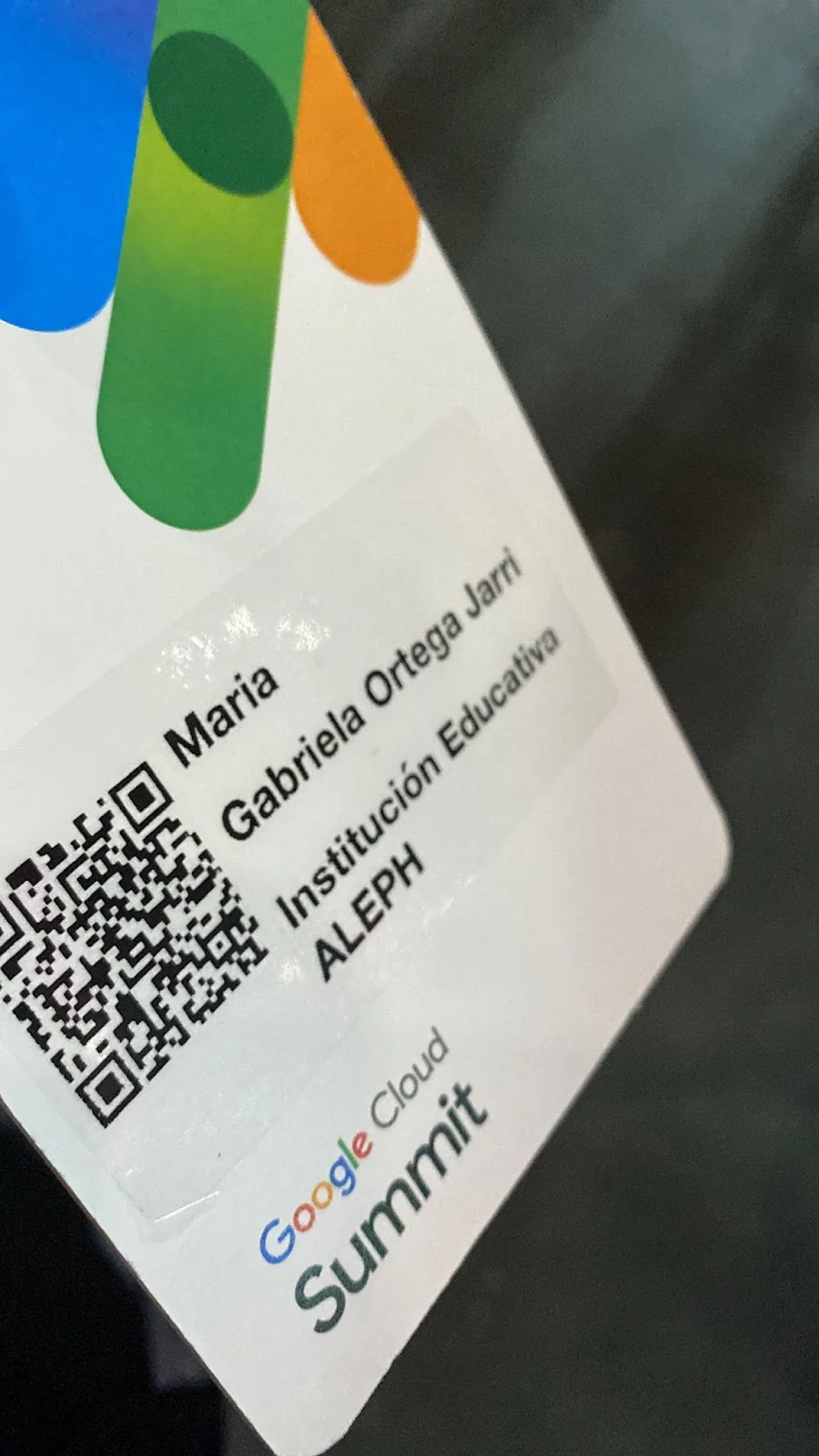
Visible badge text: “María”, “Gabriela Ortega Jarri”, “Institución Educativa ALEPH” (“ALEPH Educational Institution”), and “Google Cloud Summit”. The photographed name appears truncated on the badge; the author’s full byline is preserved above.
Cite this essay
Gabriela Ortega Jarrín. “Google Cloud Summit Madrid 2025: generative AI and the future of the public sector, with ALEPH Educational Institution as VIP guest and reporter.” estrategIA, issue 088, 4 June 2025. English edition, 29 September 2026. https://elcontemplador.github.io/estrategia-english/essays/088/