Historical context: this article was published on 13 November 2024. Its forecasts, political assessments and references to “today” retain that perspective. The quotation about xAI's stated aim is translated from the Spanish source; its original English wording has not been independently checked.
The recent US election campaign revealed a smaller role for generative artificial intelligence than many had anticipated, as we discuss in the first item in the original newsletter's news section. Despite expectations, politicians have shown an aversion to risk, avoiding technologies that might provoke a backlash in a setting where resources and traditional media remain plentiful. For example, it currently makes little sense for a national campaign with a budget of hundreds of millions of dollars — or even a well-funded House or Senate campaign — to use still-imperfect generative video AI when it can hire the best US studios to produce its adverts. While AI has played a more significant role in internal data management and campaign strategy — something we will learn more about when campaign managers and party consultants share details of their work — its public impact has been limited. Attention now turns to the future, however: what implications would a possible second Donald Trump presidency have for the development of artificial intelligence?
An OpenAI employee has suggested on X that artificial general intelligence (AGI) could be achieved during Trump's term, a prediction supported by several experts in the field. This gives us a clearer sense of how pivotal this moment could be in human history, and of its possible implications.
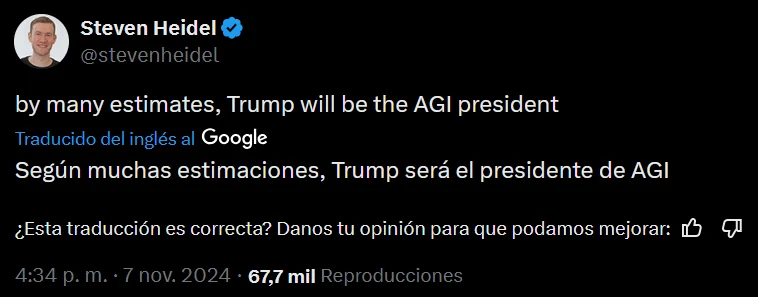
English text visible in the original screenshot, posted by Steven Heidel (@stevenheidel) on 7 November 2024:
by many estimates, Trump will be the AGI president
With this scenario in mind, we explore five key factors that could shape AI's future under a Trump administration.
1. Deregulation
At rallies late last year, Donald Trump had already expressed his opposition to Joe Biden's October 2023 executive order on AI, which established regulations and created the AI Safety Institute (AISI) under the National Institute of Standards and Technology (NIST). A new Trump administration is likely to seek to repeal or amend this legislation, taking a less regulatory approach.
Vice-president-elect J.D. Vance has said that these regulations appear to protect the interests of large technology companies more than those of consumers and small businesses. This position suggests a preference for deregulation, perhaps also support for the open-source movement and small and medium-sized businesses, allowing the AI industry to develop more freely. For a closer look at the relationship between Trump and Silicon Valley's giants, we recommend this article in eldiario.es, to which I contributed as an expert. It examines the background to this dynamic and its influence on the future regulation and development of AI in the United States.
2. An emphasis on free speech against “woke models”
A few months ago, J.D. Vance and other Republican senators sent Google a letter expressing concern about alleged ideological biases in its language models, which in some cases produced incongruous results in their attempts to avoid prejudice. They argue that current models contain political leanings that restrict freedom of expression, and propose having multiple models with different orientations.
Addressing bias in AI is a complex challenge that depends heavily on training data. Companies such as OpenAI and Google have worked to mitigate sexist or racist biases inherent in those data, but the debate over what constitutes bias and how to correct it is deeply political and social. At its heart are the questions of who defines neutrality and how to ensure that AI models reflect a diversity of perspectives without falling into bias.
3. Energy as a driver of development
Training advanced AI models requires substantial amounts of energy. Companies such as Google and Microsoft have explored options including nuclear power to meet these demands. Against this backdrop, Donald Trump has promised in campaign speeches to provide all the energy needed to drive technological innovation. This promise appeals to companies in the sector because it guarantees the energy support essential to their operations and growth.
Do not miss this video of Trump on the subject, delivered in his characteristic style.
4. Accelerating competition with China
The technological rivalry between the United States and China is a decisive factor in AI policy. A Trump administration can be expected to push AI development aggressively to secure US supremacy in this strategic field. This would mean accelerating projects, investing in research and encouraging collaboration between government and leading AI companies, all without the constraints that tighter regulation might impose.
5. Military applications of AI
The military use of artificial intelligence is a natural extension of its development. Last week, as we report in the original newsletter's news section, companies including Meta and Anthropic opened their AI models to US government agencies. Anthropic did so in partnership with Palantir, the company of Peter Thiel, a Trump “ally”. OpenAI and Microsoft had already reached similar agreements with the government.
This convergence between the AI industry and the military and security sectors reflects a strategy that benefits both sides: companies receive government support and resources, while the government gains access to cutting-edge technologies that could decisively strengthen its geopolitical position.
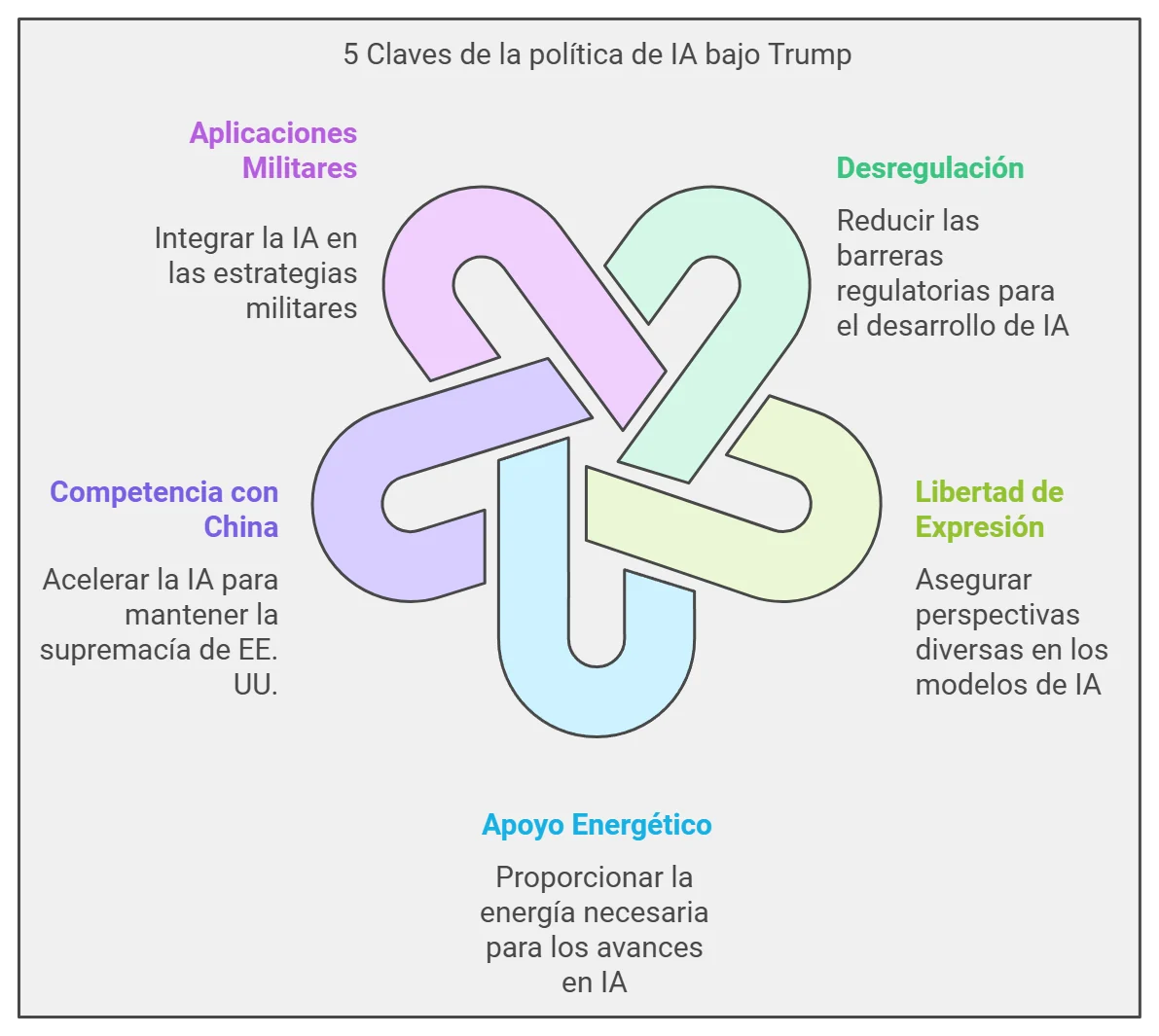
English translation of the original infographic: “Five key aspects of AI policy under Trump”.
Scroll across the table to read all columns.
| Aspect | Description |
|---|---|
| Deregulation | Reduce regulatory barriers to AI development. |
| Freedom of expression | Ensure diverse perspectives in AI models. |
| Energy support | Provide the energy needed for advances in AI. |
| Competition with China | Accelerate AI to maintain US supremacy. |
| Military applications | Integrate AI into military strategies. |
Bonus: Elon Musk's potential influence
One disruptive element in this scenario is Elon Musk's possible influence within a Trump administration. Reports today suggest that Musk will co-lead the Department of Government Efficiency. Beyond that, his wider influence could be enormous: he has already joined Trump on his first calls with Zelensky or Erdoğan, giving us a glimpse of the key role he could play in the new government.
Musk has taken varied positions on AI, perhaps for tactical reasons, perhaps out of deeply held convictions. In March 2023, he signed an open letter calling for a six-month moratorium on the development of AI systems more powerful than GPT-4, citing risks to society. Yet almost simultaneously he founded his own AI company, xAI, with the stated aim of “understanding the true nature of the universe”.
Musk has also supported regulatory initiatives such as California's AI bill, SB-1047, which Governor Gavin Newsom ultimately vetoed. It should be borne in mind that this legislation did not directly affect xAI, which he established in Nevada.
His relationships with other industry leaders are also relevant. He co-founded OpenAI with Sam Altman in 2015 but left the organisation in 2018. Since then, he has criticised its direction, particularly following its transition to a for-profit entity and its partnership with Microsoft.
There is another key proposal Musk has supported on many occasions: the creation of a universal basic income. Indeed, the last time he addressed it, in June, he spoke of a universal high income. At first sight, that might clash with Trump's policies, as might his views in other areas. The presence of this influential maverick, regarded as crucial to the Republican election victory, could alter predictions about the relationship between AI's future and the US government over the next four years.
Fernando Nieto Lobato
Director of Digital Innovation, Institución Educativa ALEPH
Cite this essay
Fernando Nieto Lobato. “Five ways the Trump administration could change the course of artificial intelligence.” estrategIA, issue 059, 13 November 2024. English edition, 29 September 2026. https://elcontemplador.github.io/estrategia-english/essays/059/