Mobile World Congress (MWC) 2025, held in Barcelona from 3 to 6 March, has closed its doors with a palpable sense that artificial intelligence is no longer a futuristic promise but the mobile industry's ubiquitous leitmotif. From the chips powering the smartphones in our pockets to the strategies of major operators and government policies, AI dominated conversations in the halls of Fira de Barcelona. Yet behind the dazzling demonstrations and grand announcements, a crucial question emerges: are we witnessing a genuine technological transformation in the present, or an elaborate performance designed simply to seduce investors and voters alike?
This year's event, which drew more than 109,000 attendees, was characterised by an “overabundance of artificial intelligence”. Mobile-device manufacturers presented their handsets as “AI companions”, integrating advanced features ranging from instant call translation to conversational assistants capable of natural, complex dialogue. The power of new chips, such as Qualcomm's Snapdragon X85 5G, with dedicated AI processors, promises to bring these capabilities directly onto the device, reducing reliance on the cloud and improving user privacy.
But AI is not confined to consumer gadgets. Major telecommunications operators also showed how they are using it to optimise their 5G networks and prepare the ground for 6G. Huawei, for example, presented “AI-centred 5.5G” solutions, promising smarter, more autonomous and more energy-efficient networks. Samsung, meanwhile, showcased CognitiV NOS, its network-automation platform, capable of managing the network lifecycle autonomously, anticipating congestion and adjusting resources in real time. Even start-ups such as DeepSig are revolutionising the physical layer of communications, replacing traditional algorithms with neural networks that learn and adapt to wireless-channel conditions, with substantial improvements in spectral efficiency.
In cybersecurity, AI emerges as a double-edged sword. While companies such as Telefónica Tech showed how AI can detect and neutralise cyberthreats in record time, experts warn that malicious actors are also using it to make their attacks more sophisticated. The industry is engaged in a digital arms race in which defensive AI must stay one step ahead of new forms of cybercrime.
AI's ethical imperative: navigating the fine line between innovation and regulation
The technological euphoria that swept through MWC 2025 did not eclipse an increasingly urgent debate: the need for a robust ethical and regulatory framework for artificial intelligence. As AI spreads into every area of life, from health to government, the question is no longer whether we should regulate it, but how to do so effectively without stifling innovation.
A pivotal moment in this debate was the contribution of Apple co-founder Steve Wozniak. Far from adopting a Luddite position, he advocated “more honest AI”. A longstanding advocate of technological oversight, Wozniak stressed the importance of algorithmic transparency: “To judge what we consume more effectively, we need to know whether the information comes from technology, how the AI has been trained, or which sources it has used.” His call echoed an underlying concern at the congress: users' right to know when they are interacting with AI and the ethical parameters or biases under which it has been trained.
Translation note: Wozniak's quoted remarks are translated from the Spanish wording in the original article; their original English wording has not been independently verified.
At MWC 2025, many companies showed a growing awareness of the need to adapt to this new regulatory landscape. Samsung, for example, stressed that all the AI features in its Galaxy S25 devices are designed with privacy in mind. The company presented its “Personal Data Engine”, an architecture that processes personal data locally on the device and deletes it if the user wishes.
Spain, seeking to position itself as a significant player in the AI ecosystem, also made important announcements on ethics and regulation. The Secretariat of State for Digitalisation and Artificial Intelligence launched an open-source community for the development of ALIA, the family of foundation AI models in Spanish and Spain's co-official languages. Opening ALIA's code aims to foster transparency, auditability and collaboration around AI “made in Spain”, incorporating European values such as privacy and inclusivity by design.
Questions remain, however, about the feasibility of effective regulation in a technological field evolving at breakneck speed. Will the EU AI Act be flexible enough to adapt to future innovations? How will compliance be guaranteed globally, given AI's cross-border nature? And perhaps the most fundamental question: how can the need for regulation be balanced with the imperative to foster innovation and economic growth? Far from having easy answers, these questions will shape the political and technological agenda in the years ahead.
The intelligent state: governments trying to ride the AI wave
MWC 2025 made clear that artificial intelligence is not merely a technological toy for the private sector, but an instrument of power with transformative potential for governments and public administrations. In a global context of accelerating digitalisation and increasingly complex social challenges, states are beginning to see AI as a strategic ally in modernising services, improving administrative efficiency and, ultimately, strengthening their legitimacy in citizens' eyes.
Spain once again emerged as an example of this trend. The Minister for Digital Transformation announced an ambitious €200 million package at MWC to integrate AI into the Spanish economy. The investment, part of the Digital Spain 2026 agenda and the National AI Plan, seeks to advance AI projects in businesses across sectors, from manufacturing to tourism and healthcare. A notable element is the €67 million investment in Multiverse Computing, a Spanish pioneer in efficient AI, in a clear attempt to advance AI's energy sustainability and put Spain “at the forefront of Europe” in this field, in Minister López's words.
Beyond investment, MWC 2025 also offered concrete examples of how AI could revolutionise public administration. Discussions covered the potential of intelligent virtual assistants to simplify bureaucratic procedures and provide round-the-clock citizen services, following countries such as Estonia, which have already implemented government chatbots.
At local level, Barcelona, MWC's host city, reinforced its ambition to become an AI technology hub through a strategic agreement with Huawei. The agreement envisages training centres for advanced digital skills and the development of AI-based smart-city pilots, such as predictive urban traffic-management systems or urban maintenance using computer vision to detect damage to streets.
The GSMA Ministerial Programme, held alongside the congress by the organisation representing the mobile industry worldwide, provided a platform for ministers and representatives from more than 40 countries to discuss digital policies and AI's role in governance. They discussed public-administration use cases such as analysing public data to improve urban transport planning or detect tax fraud. There was broad agreement that governments should lead by example in ethical AI adoption, using open, privacy-respecting solutions. In this context, the European Commission presented Digital Europe Programme initiatives in its pavilion, including a demonstration of AI serving social inclusion: a computer-vision system to help people with disabilities navigate events.
AI's influence was visible even in institutional promotion. The Spanish government's pavilion at MWC, which attracted 30% more visitors than the previous year, featured an interactive AI hologram that welcomed visitors and recommended companies to visit according to their interests. Beyond the novelty, it illustrates how AI is beginning to permeate every aspect of public life, from citizen services to promoting the national brand.
Government adoption of AI is not without challenges, however. A shortage of specialist AI talent in the public sector, resistance to change within traditional administrative structures, and concerns about the security and privacy of citizens' data are obstacles that must be overcome. There is also a continuing risk that AI will be used to reinforce state control and surveillance, rather than empower citizens and improve public services. The key to an “intelligent state” lies in a delicate balance between technological efficiency and democratic values.
Future trends glimpsed at the congress
The innovations presented at MWC 2025 offer a glimpse of several future trends in AI:
- Ubiquitous AI in personal devices: flagship smartphones already act as proactive assistants, and these functions can be expected to reach mid-range and entry-level devices in the coming years. We will see more sophisticated AI running offline on our phones, thanks to increasingly powerful chips and compressed models. Users will become accustomed to interacting with their phones by voice for all kinds of tasks, blurring the line between phone and virtual assistant.
- Autonomous networks on the road to 6G: AI integration into networks will continue to grow. Operators will seek self-managing networks that optimise and repair themselves without human intervention. The idea of neural networks for communications could take hold if experiments such as DeepSig's continue to bear fruit. This could shorten innovation cycles in telecommunications. We will also see AI in services running over the network: for example, 5G network slices dedicated to AI-powered extended-reality services, or adaptive quality of service depending on whether the network detects a critical application—an autonomous car, for example—or a non-critical one.
- More human-like assistants and bots: the next generation of assistants—Siri, Alexa and Google Assistant—will probably incorporate advances from ChatGPT and Gemini. After what we saw at MWC, we expect more conversational, context-aware and multimodal assistants. “Metabots” could emerge, combining several specialised AIs, as with Deutsche Telekom, T-Mobile's parent company, which presented its innovative “AI Phone”, combining Perplexity, Google AI, ElevenLabs and Picsart.
- Generative AI in every sector: we saw AI applications in health, education, finance, government and more. The trend is for no sector to remain untouched. Traditional companies are moving from pilots to real deployments, albeit slowly. As regulation matures and successful use cases emerge, future editions of MWC could show large-scale implementations: cities with AI-controlled traffic lights responding to real-time flows, health systems using AI for diagnosis in primary care, and courts applying AI to case management, always with human oversight. Public–private collaboration will be important in scaling these projects swiftly.
- An emphasis on ethics, privacy and sustainability: AI's future will be shaped by how well its ethical challenges are addressed. Privacy will remain a hot topic: local AI use may increase so that data does not leave the device. We will also see efforts towards “green” AI, optimising models to consume less energy in view of the growing environmental costs of large AI data centres.
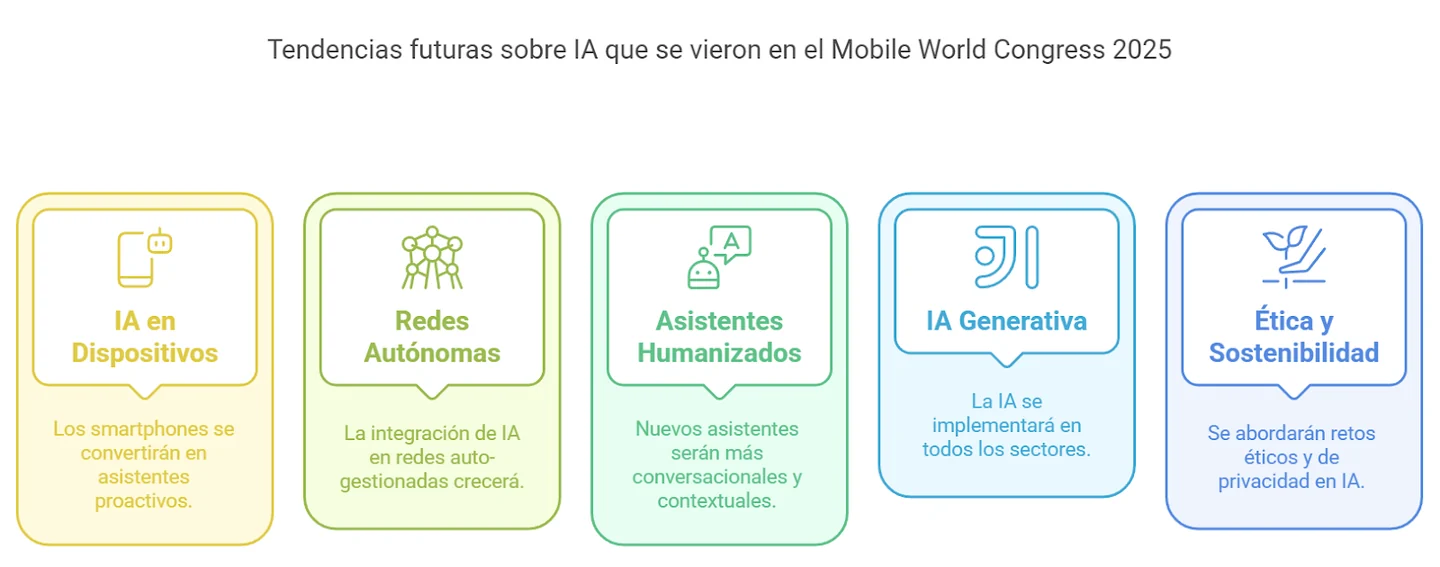
Full translation of the infographic, “Future AI trends seen at Mobile World Congress 2025”:
Scroll across the table to read all columns.
| Trend | Description |
|---|---|
| AI in devices | Smartphones will become proactive assistants. |
| Autonomous networks | AI integration into self-managing networks will grow. |
| Human-like assistants | New assistants will be more conversational and context-aware. |
| Generative AI | AI will be implemented in every sector. |
| Ethics and sustainability | AI's ethical and privacy challenges will be addressed. |
MWC 2025 made clear that artificial intelligence has moved from promise to the central axis of mobile technological innovation. From the most basic chip to the most strategic government decisions, AI lay at the heart of every announcement. Improvements in hardware, the maturity of language models and the post-pandemic urgency to digitalise processes have converged to make 2025 the year of AI's explosion in connected mobility. Users can expect smarter devices and more personalised services; operators, more efficient networks; businesses, new opportunities; and governments, tools to serve citizens better. Challenges remain—interoperability, regulation and developing AI talent—but the direction is clear. AI is no longer just a trend: it is a reality cutting across sectors that will probably continue to dominate headlines at future editions of MWC, perhaps with less hype and more concrete results. As Barcelona showed, we are entering a stage of “AI in practice”: moving beyond the laboratory and the demo to integrating it fully into our lives, usefully and responsibly. The cards have been dealt, and future editions of the congress will reveal how much of what was announced becomes real products and policies in the global AI market.
Fernando Nieto Lobato
Director of Digital Innovation at the ALEPH Educational Institution
Cite this essay
Fernando Nieto Lobato. “AI takes the lead: what Mobile World Congress 2025 tells us about the digital future.” estrategIA, issue 076, 12 March 2025. English edition, 29 September 2026. https://elcontemplador.github.io/estrategia-english/essays/076/