Historical context: this article was published on 21 May 2025. Its tools, assessments and forecasts refer to that date. “Yesterday” means 20 May 2025; the classroom exercise deliberately recreates a US election scenario beginning on 1 January 2024.
A year ago, in four issues of estrategIA published between April and June 2024 (28, 29, 30 and 36 — we recommend reading them if you did not do so at the time), we used the best AI tools and models then available to create a political party and a female candidate, and simulated several key campaign tasks for the European Parliament elections held on 9 June. The “experiment” was also presented in September in Málaga at the ACOP conference — the Political Communication Association — where it attracted considerable interest.
Now, a year later, we have recreated that experiment to observe and assess the capabilities of the new AI models and how far things have advanced in just one year.
The main difference is that this time I was not the only person creating the party, candidate and campaign. I also set it as an academic assignment for several groups of students on ALEPH Educational Institution’s Master’s in Marketing, Communication and Political Consultancy and Diploma in Digital Election Campaign Management, because I consider it an excellent practical way to learn how to integrate AI into real work.
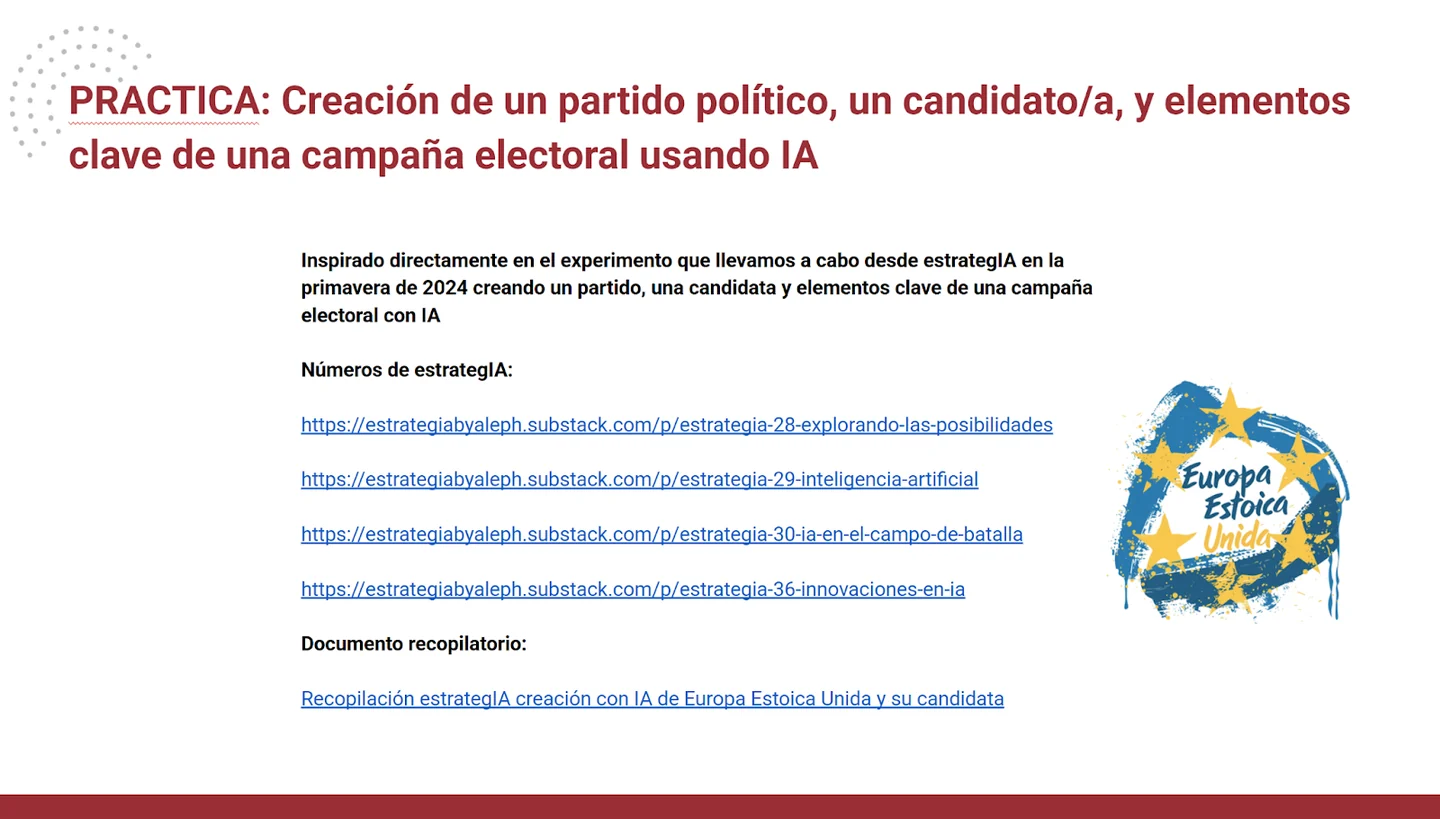
English text of the slide: “EXERCISE: Creating a political party, a candidate and key elements of an election campaign using AI.” “Directly inspired by the experiment we carried out at estrategIA in spring 2024, creating a party, a female candidate and key elements of an election campaign with AI.” It lists estrategIA issues 28, 29, 30 and 36, linked above, and a compilation document: “estrategIA compilation: creating Europa Estoica Unida and its candidate with AI”. The party logo reads “Europa Estoica Unida” (“United Stoic Europe”). The preserved slide does not supply the compilation document’s destination.
The biggest change, intended to make the task easier for students who mainly come from Latin America — while retaining a real setting that allowed them to go deeper into political and sociological data — was to move the scenario to the United States and propose creating a third political party there, one that could offer, to some extent, an alternative to the two traditional parties.
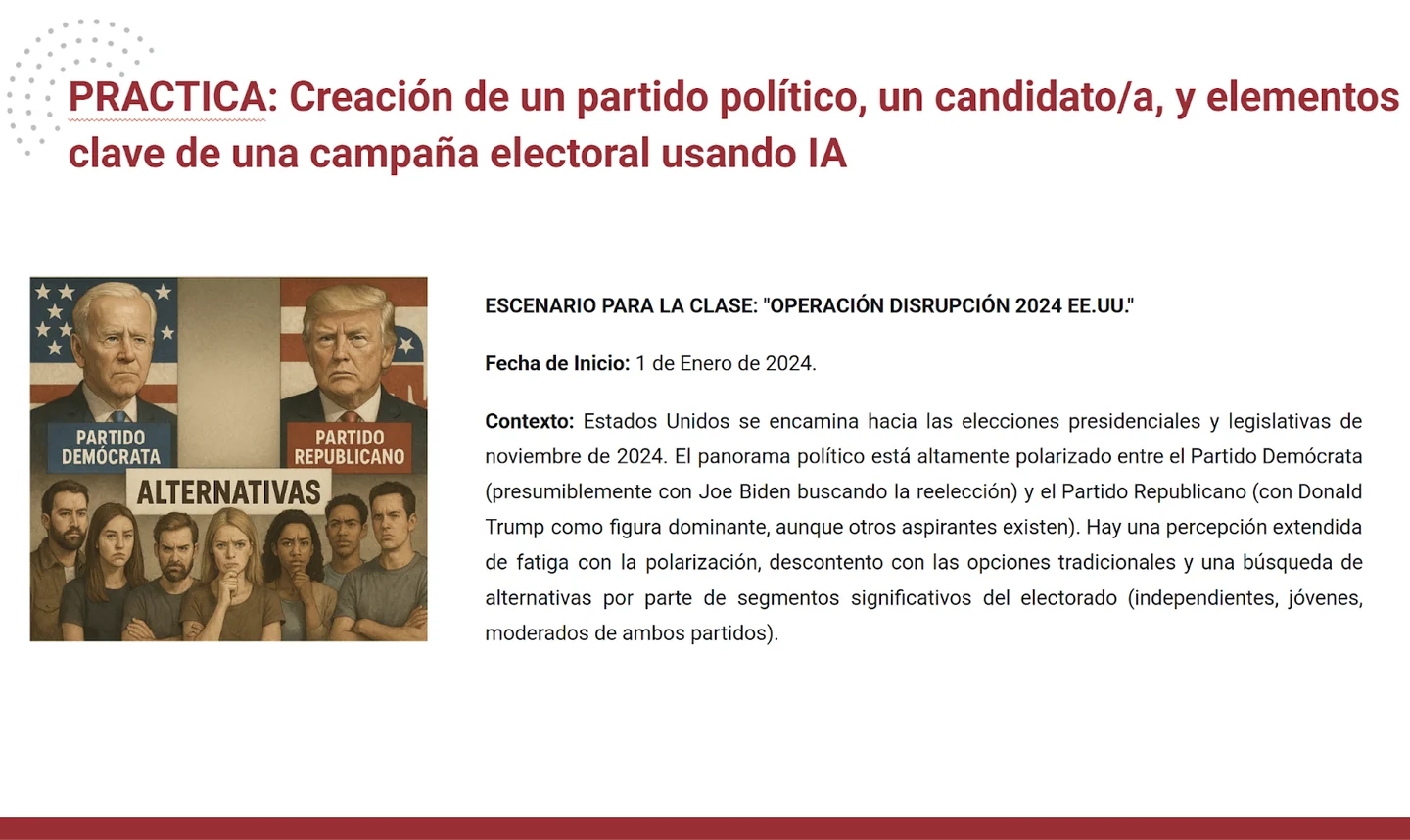
English text of the slide: “EXERCISE: Creating a political party, a candidate and key elements of an election campaign using AI.” “CLASSROOM SCENARIO: ‘OPERATION DISRUPTION 2024 USA’.” “Start date: 1 January 2024.” The context is the United States approaching presidential and legislative elections in November 2024, with intense polarisation between the Democratic Party, presumably with Joe Biden seeking re-election, and the Republican Party, dominated by Donald Trump despite other contenders. Widespread fatigue with polarisation, dissatisfaction with traditional options and a search for alternatives affect significant parts of the electorate: independents, younger voters and moderates in both parties. The illustration labels read “DEMOCRATIC PARTY”, “REPUBLICAN PARTY” and “ALTERNATIVES”. These are the premises of the historical classroom simulation.
Without going into every detail of the extensive exercise, which is not especially relevant to this article, after a theoretical introduction to AI and its possibilities the students received some additional contextual pointers and a collection of the frontier generative AI tools publicly available today. Alongside creating the party, candidate and key campaign materials such as speeches, talking points and posters, they were asked to write a brief reflection on using AI for these tasks. And because when one person teaches, two people learn, I learnt a great deal from this excellent group of students, with their interesting and varied professional backgrounds. I want to share that with you, our readers, before offering my own reflections on generative AI’s progress over the past year.
Notable reflections from — and with — the students after the exercise
1. AI brings a very substantial improvement to 70% of processes and tasks, but the human 30% remains crucial today and is probably what makes the difference.
I must say that I very much agree with this student’s reflection, shared by most of the group. It is before working with AI — knowing what to ask it, how to ask, having the imagination to devise scenarios — and after its answer — our ability to evaluate it, check the information, ask follow-up questions or challenge the AI again — that we find a very substantial difference in the final results of AI-assisted processes in 2025. That said, over a five- or ten-year horizon, this crucial human contribution is very likely to diminish progressively as models become more capable and intelligent, acquire highly advanced memories of our habits and preferences, and transform the process. Even so, at least until artificial intelligences reach that still-distant point of having a will of their own, human initiative will remain essential.
2. AI improves when it is “pushed”.
Both in last year’s experiment and in several tests I carried out in 2025, you can see that AI’s initial answers are not bad, and are improving as the models improve, as I will discuss below. Yet they can be somewhat generic or “soulless”. Some student groups said they had observed the same thing. Several groups’ work also showed that when human ingenuity puts these models under pressure, pushes them in different directions and uses several AIs creatively at the same time, more innovative and distinctive answers and solutions emerge. As we discussed in the first point, the human contribution following the AI process makes a difference today, even though AI already does the vast majority of the work.
3. The more someone knows about a subject, the better equipped they are to get good results from working with AI.
Several students with advanced knowledge in particular fields demonstrated highly complex, finely tuned workflows in their presentations that would never have occurred to me, for example, despite spending many hours every day working with AIs. These more precise, specific approaches, drawing on all that expert knowledge, produce excellent results beyond what AI might generate from general queries. As an anecdotal example of the opposite, one election poster a group proposed in its presentation had some interesting elements, but used a typeface that would have made my university design lecturer’s eyes bleed: he would never have approved such an atrocity.
4. AI is being used much more — and better — than a year ago, but we are still a long way from making full use of its potential.
Many students have already integrated AI thoroughly into their everyday work. I ran a survey before the classes both this year and last to establish their starting point, and between 2024 and 2025 the number of people using AI daily, and also paying for at least one AI tool, grew very significantly. AI is already seen as a fully valid ally in political consultancy, yet many people said they used it almost on autopilot. I think one benefit of this exercise is that it can help people open their minds to using more AI, but above all to using it more creatively: working with several models at once, getting different models — even those from very different cultures, such as Silicon Valley, China and Europe — to generate ideas, debate and correct one another. The technology is improving very rapidly. One student who had used Gemini some time ago, for example, said she had tried it again after I mentioned its enormous improvement in the first class and had noticed a huge difference. We need to retain a beginner’s mindset towards it and never tire of testing and experimenting.
5. Using AI: that moment of discovery
From a teacher’s perspective, it has been fascinating to see how some people who had never used AI, or had barely used it, were beginning in just a few days to find it useful and improve their capabilities, without losing a critical, balanced view of it. One of the final questions, which I could not explore fully for lack of time, concerned how to persuade other colleagues to use it, or introduce it to people who barely do. My main recommendation here, which I also gave the students in our first class, is Wharton professor Ethan Mollick’s book, Co-Intelligence, with its four basic rules for using AI, still very valid today: “always invite AI to the table; be the human in the process; treat AI like a person; assume it is the worst AI you will ever use”. It was this last point that I particularly emphasised in the theoretical part of the classes, because I feel that even these postgraduate students, whose average use of AI is notably advanced, are still far from understanding “what is coming” and the new possibilities they will have in the years ahead.
Translation note: the four rules attributed to Mollick above are translated from the Spanish wording in this article; they are not presented as verified quotations from the English original.
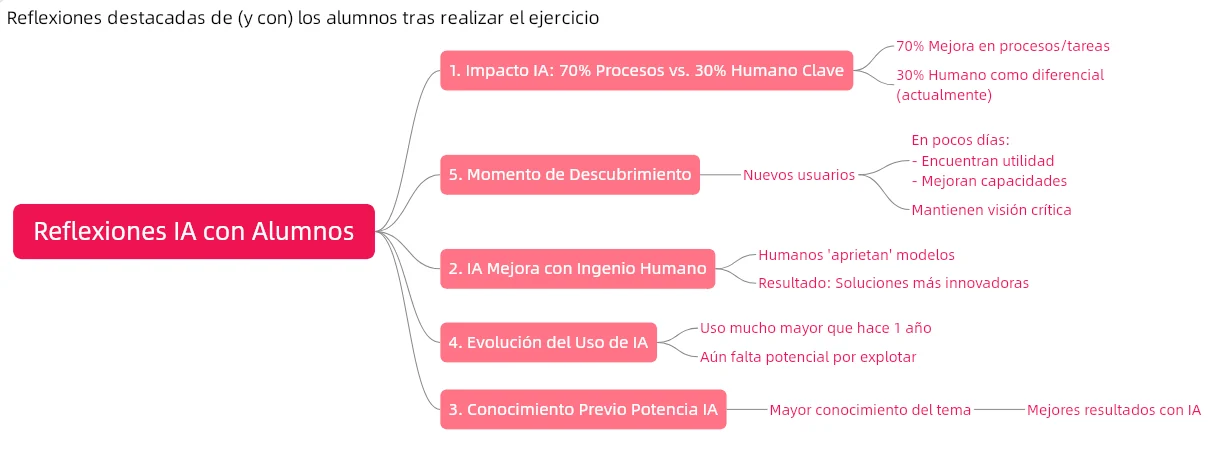
English text of the mind map — “Notable reflections from (and with) students after the exercise”; centre: “AI reflections with students”:
- 1. AI’s impact: 70% of processes versus a crucial human 30%. 70% improvement in processes/tasks; the human 30% as the differentiating factor, currently.
- 5. A moment of discovery. New users, within a few days: find it useful, improve their capabilities and retain a critical perspective.
- 2. AI improves with human ingenuity. Humans “push” models; the result is more innovative solutions.
- 4. The evolution of AI use. Much greater use than a year ago; potential still remains untapped.
- 3. Prior knowledge strengthens AI use. Greater knowledge of the subject leads to better results with AI.
How AI has progressed over the past year in political consultancy
My own reflections, many of them formed before the classes and confirmed afterwards, focus on comparing where we are with where we were a year ago. Before setting the exercise for the students, I completed its entire text component with five different AI models, then ran many tests with other tools for images, music and so on.
1. Reasoning models make an enormous difference.
The leap brought by o1 and o1-preview late last year, and now by models such as o3 and Gemini Pro 2.5, gives us a substantial increase in quality compared with this time in 2024, especially on complex tasks. Meanwhile, improvements in “normal” models, through the almost monthly iteration of, for example, 4o, ChatGPT’s default model, also mean that results are better than a year ago even when we use models that do not “think”. For more complex tasks, however, the quality achieved with AIs that use “time to think” is much higher.
2. “Deep research” is a turning point in working with data and analysing the political context.
Using OpenAI’s Deep Research with o3, or Google’s with Gemini 2.5 Pro, with good direction, means having an initial report of 40 or 50 pages containing key statistical data — in this case, on the US context in 2024. Even so, it is essential to check the data carefully and remember that these advanced models still hallucinate and may invent things. They remain far from perfect and entirely reliable, but offer enormous power to grasp context and broaden our perspective in the tens of minutes they take to conduct research that would take an average person many hours. And we must always remember: they are “the worst model we will use for the rest of our lives”.
3. A larger context window means much more coherent results.
Improvements in context windows — these models’ ability to work with ever more data — make all the difference. We can now work while carrying forward all the information from previous stages. This enables models, especially reasoning models, to give much more coherent answers, drawing on all the knowledge generated rather than having to start almost from scratch with every interaction and question.
4. Many more high-quality models for generating images.
There has been a noticeable leap in image generation, perhaps less in the quality of the image itself — although that too has improved, and Midjourney 6, which we used in 2024, was already a very interesting tool — than in the range of possibilities. There are now many more models capable of generating high-quality, even photorealistic images. Above all, there is the ease of use and adherence to prompts — following our instructions — of models such as OpenAI’s in ChatGPT or Imagen 4, which Google introduced yesterday, 20 May.
5. Notable improvements across all fields and tools.
There has also been a notable leap in other AI-powered tools, such as audio, infographics and presentations. Above all, this will enable us to do new things professionally in the near future.
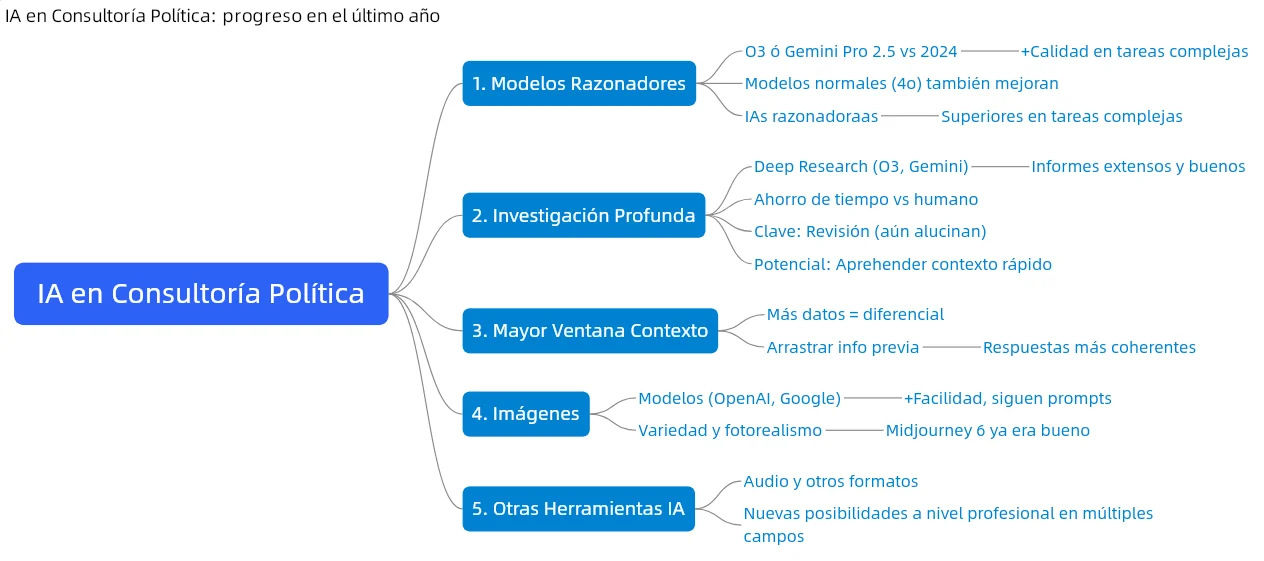
English text of the mind map — “AI in political consultancy: progress over the past year”; centre: “AI in political consultancy”:
- 1. Reasoning models. o3 or Gemini Pro 2.5 compared with 2024: higher quality on complex tasks. Normal models such as 4o also improve. Reasoning AIs are superior on complex tasks.
- 2. Deep research. Deep Research with o3 or Gemini: extensive, good reports. Time savings compared with human work. Crucial: review, because they still hallucinate. Potential: grasping context quickly.
- 3. Larger context windows. More data makes a difference. Carrying previous information forward produces more coherent answers.
- 4. Images. OpenAI and Google models: easier to use and follow prompts. Variety and photorealism: Midjourney 6 was already good.
- 5. Other AI tools. Audio and other formats. New professional possibilities across multiple fields.
To illustrate this last point, I generated a very simple video game, fitting the context of the students’ exercise, mainly using o3 and o4-mini. I also made a very similar alternative version with Gemini 2.5 Pro.
I invite you to have a quick game — it may not display well on mobile phones, depending on the model — and try to bring the third party to electoral victory by jumping over the Democrats’ and Republicans’ traditional symbols, the donkey and the elephant, and collecting ballot papers.
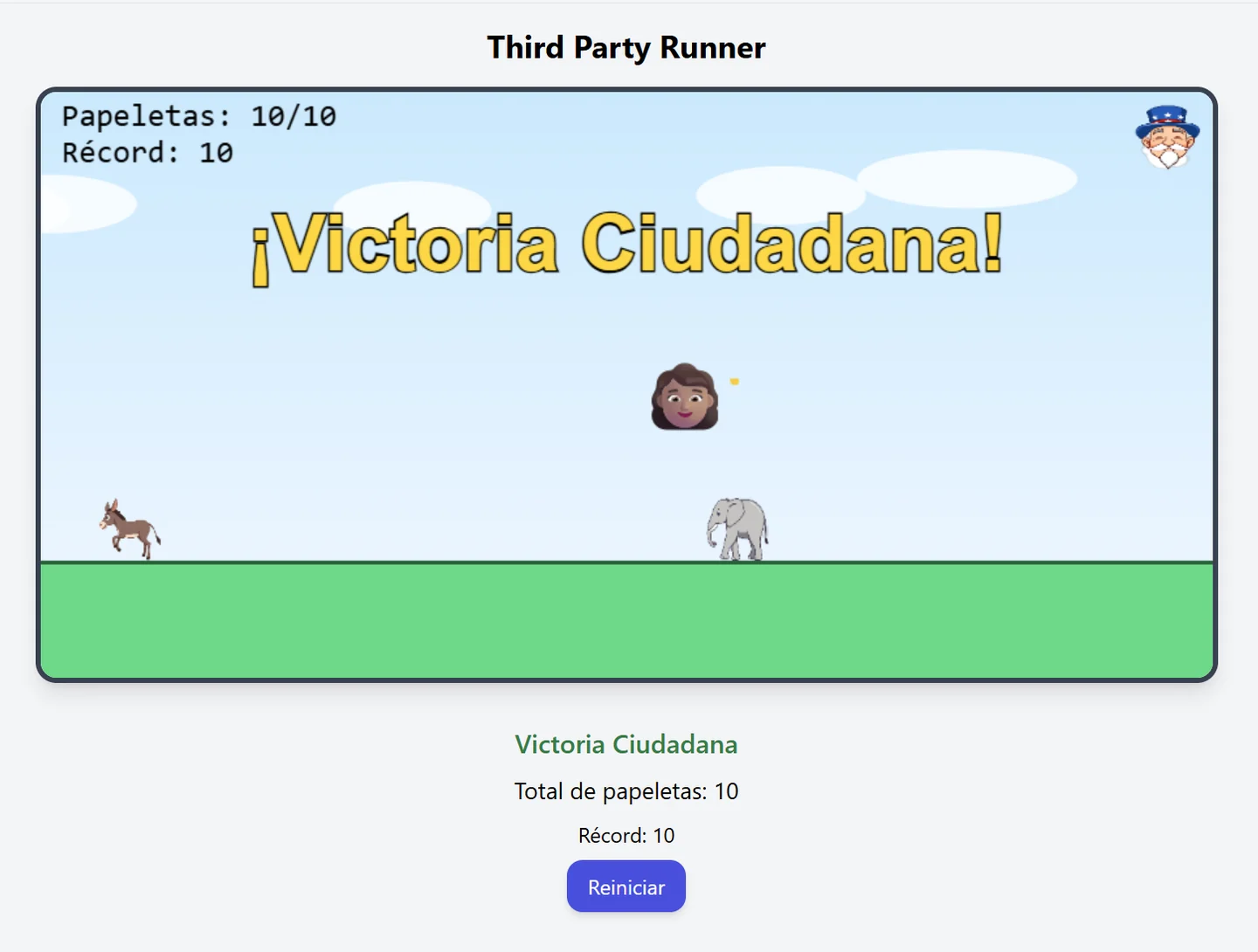
English text of the game screen: “Third Party Runner”; ballot papers: “10/10”; record: “10”; “Citizens’ victory!”; “Citizens’ victory”; “Total ballot papers: 10”; “Record: 10”; “Restart”. The game features a female character jumping over donkey and elephant obstacles.
Clearly, it is a very simple, “bad” game, a sort of extremely basic side-scrolling sketch of Mario Bros. Yet I did not touch a single line of code to make this example, and finishing it took no more than a couple of hours. Most of that time was not spent generating the game itself: I wanted a platform where I could make it publicly available for you to see and play. I eventually used Websim for its simplicity, after first trying Firebase and Bolt.new. Creating the first version in ChatGPT took less than three-quarters of an hour.
The entire game was created simply by giving the AI models general text instructions. Beyond the modest, simple result, the point is that in future we will be able to create video documentaries about candidates, games and virtual environments as easily as we now create images or songs. One student said that last year they had already generated a song with Suno for an election campaign that was perfectly usable and that they had actually booked airtime for on the radio. Even in very modest campaigns, we will be able to see surprising innovations in creative communication.
Final reflections and trends
Beyond the incremental yet very significant year-on-year improvements in generated content, and the addition of deep research as a major advance, it is essential to recognise that these developments will by no means stop at this level. We will see further major improvements in reasoning models’ intelligence and capabilities, in deep research powered by those new models — one key to understanding its ceiling will be whether higher-quality data can be accessed — and, above all, in the memories and context windows of these models. According to statements from several researchers, these will grow very significantly in the coming months and years, allowing AIs to develop much more personalised, finely tuned knowledge, another highly significant improvement.
In other fields, such as images, where we are already very close to models that recreate reality and make doing so easy, as well as video, interactivity, virtual and augmented reality, we will undoubtedly see decisive improvements in the next few years. Already, the Veo 3 model Google presented yesterday is an extraordinary advance. So next year or the year after, I will surely be able to ask students to generate campaign videos almost as easily as they now make images or songs, and possibly also to create much more elaborate video games or key applications that improve campaigns’ efficiency or reach.
To sum up, AI’s dizzying evolution suggests that we will very probably be able to do things we could not previously even have dreamed of. Pioneers who make use of all these new possibilities, drawing fully on their own knowledge and that of the AIs they work with, will have an enormous competitive advantage.
I will close this article with the same two sentences I used to end my theoretical class:
Artificial intelligence is quite likely to transform the world profoundly and rapidly over the next few years.
In that scenario, learning about this technology and integrating it into our professional work seems the best possible option for “enjoying” the change rather than “suffering” it.
Director of Digital Innovation, ALEPH Educational Institution
Cite this essay
Fernando Nieto Lobato. “Repeating the AI election experiment a year later — with our students: what has changed in twelve months.” estrategIA, issue 086, 21 May 2025. English edition, 29 September 2026. https://elcontemplador.github.io/estrategia-english/essays/086/