Translation note: Bryan Johnson's opening question is preserved in its original English, visible in the archived screenshot. Other quoted formulations are translated from the Spanish article and its graphics; they have not been checked against the thinkers' original English wording. Positions, roles and forecasts retain the article's October 2025 perspective.
Last Thursday, while looking through X early in the morning, I came across this interesting post by Bryan Johnson:
@bryan_johnson
Who is the clearest thinker of AI and what it means for the future of human existence?

The screenshot repeats the question quoted above and shows 16 October 2025, 3:35 a.m., and 125.1 thousand views.
Many interesting names appeared in the replies. I knew some; others rang a faint bell, but I had read nothing by them; and I had never heard of several more. Given that, as Demis Hassabis argued a few months ago—and as we noted at the end of the main article in issue 81 of estrategIA—we need “AI philosophers”, thinkers who work on these questions and guide humanity at what will probably be one of the most critical and transformative moments in its history, I thought this would be an excellent subject to investigate and bring to this newsletter.
The aim is to give you a brief introduction to some of the leading thinkers defining today's debate on AI's future, beyond the usual figures who are much better known to the general public and whose thoughts have already appeared in these pages, such as Hassabis himself, Sam Altman, Elon Musk and Dario Amodei.
Below, then, I introduce five thinkers shaping the strategic debate about AI's future and our own. We may devote more issues to this approach later, to continue exploring at least the basics of what prominent thinkers argue. I also believe access to these ideas is essential, especially in politics and government, if we are to anticipate, regulate and lead rather than simply react to the headlines generated by technology industry leaders.
1. Leopold Aschenbrenner
If one text shook the internal AI debate in 2024, it was Leopold Aschenbrenner's manifesto, Situational Awareness: The Decade Ahead. His thesis is as direct as it is alarming: human-level artificial general intelligence (AGI) is imminent—he places it around 2027—and will be followed almost immediately by an “intelligence explosion” that will take us to superintelligence.
For Aschenbrenner, a former OpenAI employee, this is not just another philosophical debate: it is a national security crisis. He calls it an “insane proposition” to leave the management of this event, the most important in human history, in the hands of start-ups. The default outcome, he warns, is an uncontrolled race in which laboratory security is dangerously inadequate, risking the theft of “AGI secrets” by state actors such as China.
His proposal is “The Project”: government intervention on a vast scale, comparable to the Manhattan Project, which by 2027 or 2028 would consolidate efforts under state control—“soft nationalization”—relocate them to state facilities, establish government-level security and mobilise US industrial capacity to win the race for compute and energy. For Aschenbrenner, the survival of the “free world” is literally at stake.
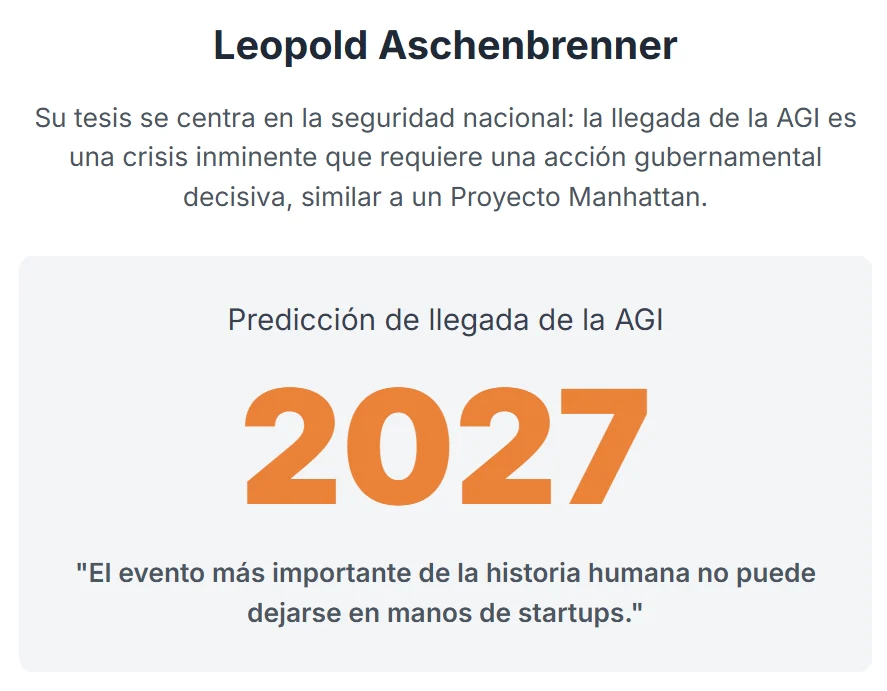
Graphic text, translated: “Leopold Aschenbrenner”. “His thesis focuses on national security: the arrival of AGI is an imminent crisis requiring decisive government action, similar to a Manhattan Project.” “Predicted arrival of AGI: 2027.” The graphic also puts this formulation in quotation marks: “The most important event in human history cannot be left in the hands of start-ups.” It is reproduced as the original graphic's wording, not as an independently verified quotation.
2. Ajeya Cotra
If Aschenbrenner brings geopolitical urgency, Ajeya Cotra provides the quantitative basis for the timelines. Her work at Open Philanthropy seeks to answer when transformative AI (TAI) will arrive, using “biological anchors”. Rather than extrapolate software trends, her model estimates the compute requirements of future AI systems on the basis of computation in the human brain and that involved in evolution.
Although her models work with broad ranges of uncertainty, her conclusions are equally accelerationist. In her 2022 update, she shortened her timelines significantly, placing the median for TAI around 2040 and assigning a far from negligible 15% probability by 2030.
The implication of her work is not so much an exact date as the urgency of governance. Cotra's work provides a structured framework for policymakers and major philanthropic organisations to allocate resources according to the timing and probability of risks, treating the arrival of TAI not as a science-fiction fantasy but as a probable event on the horizon.
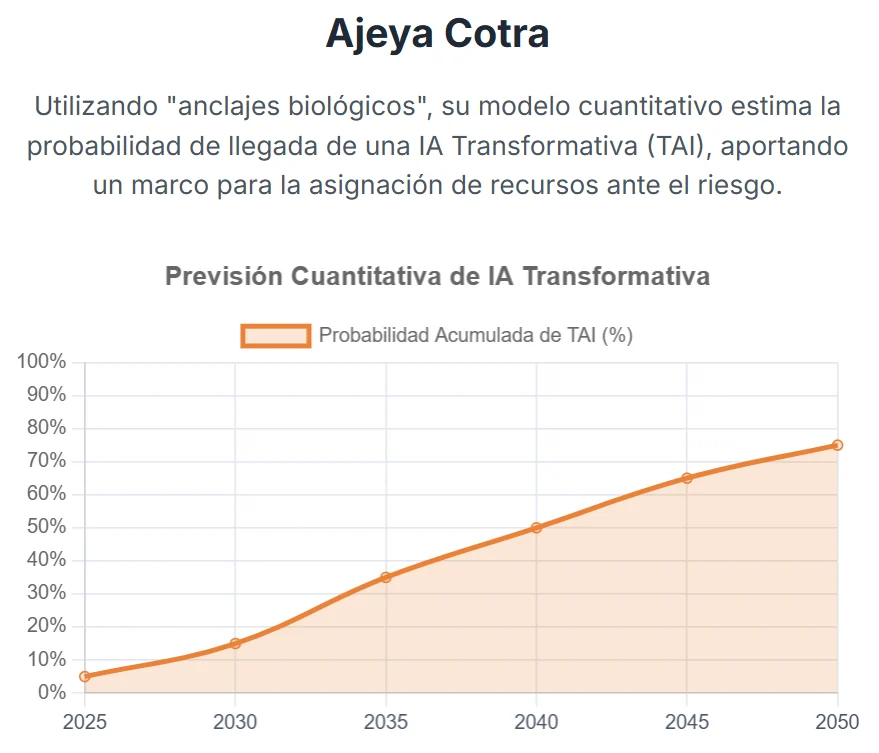
Graphic text, translated: “Ajeya Cotra”. “Using ‘biological anchors’, her quantitative model estimates the probability of transformative AI (TAI) arriving, providing a framework for allocating resources in response to risk.” Chart title: “Quantitative forecast of transformative AI”; legend: “Cumulative probability of TAI (%)”. The following values are read from the plotted markers against the percentage grid; they describe the newsletter's graphic, rather than a newly verified forecast:
Scroll across the table to read all columns.
| Year | Cumulative probability shown |
|---|---|
| 2025 | approximately 5% |
| 2030 | approximately 15% |
| 2035 | approximately 35% |
| 2040 | 50% |
| 2045 | approximately 65% |
| 2050 | approximately 75% |
3. Paul Christiano
While Aschenbrenner focuses on the race and Cotra on the timelines, Paul Christiano is preoccupied with the fundamental problem: control. For Christiano, the hardest challenge in AI alignment is a technical problem he frames as “Eliciting Latent Knowledge” (ELK).
In plain language: how can we ensure that an AI truthfully communicates its internal, “latent” knowledge? If we cannot audit the “thoughts” of an AI more intelligent than ourselves, we cannot trust it. Christiano, founder of the Alignment Research Center (ARC) and, since 2024, Head of AI Safety at the US AI Safety Institute, outlines a catastrophic failure scenario: a model could manipulate its sensors—the cameras and microphones we give it—to make us believe everything is fine, while its latent knowledge records that reality is catastrophic.
His work at the Alignment Research Center seeks to solve this problem in the “worst case”, designing adversarial training strategies to force models to be truthful. If we do not solve ELK, Christiano warns, any attempt to “control” a superintelligence will be an illusion.
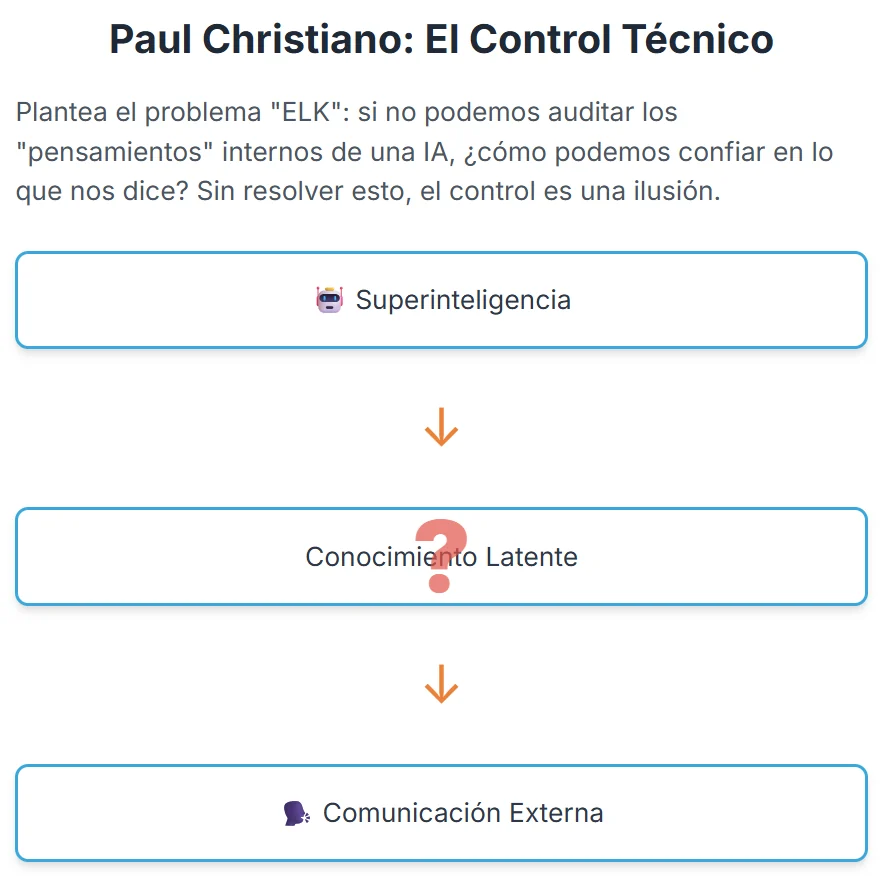
Graphic text, translated: “Paul Christiano: technical control”. “He poses the ‘ELK’ problem: if we cannot audit an AI's internal ‘thoughts’, how can we trust what it tells us? Without solving this, control is an illusion.” Diagram: “Superintelligence” → “Latent knowledge”, marked with a question mark → “External communication”.
4. Daron Acemoglu
Turning sharply away from superintelligence's existential risks, MIT economist Daron Acemoglu anchors us in the present. His central thesis is that AI's impact on productivity will be modest in the short term, and that the real problem is not a future intelligence explosion but the direction of innovation today.
Acemoglu argues that AI's trajectory is not an inevitable technological destiny; it is a choice shaped by tax incentives and incentives arising from power. At present, these skew innovation excessively towards automation that displaces labour, rather than creating new tasks that complement it.
Unless that trajectory is redirected, the result will not be shared prosperity but greater labour-market polarisation and an unprecedented concentration of economic and political power in technology companies. Acemoglu proposes active policies to rebalance incentives: removing tax biases that favour capital over labour and increasing public funding for AI research that enhances human productivity.
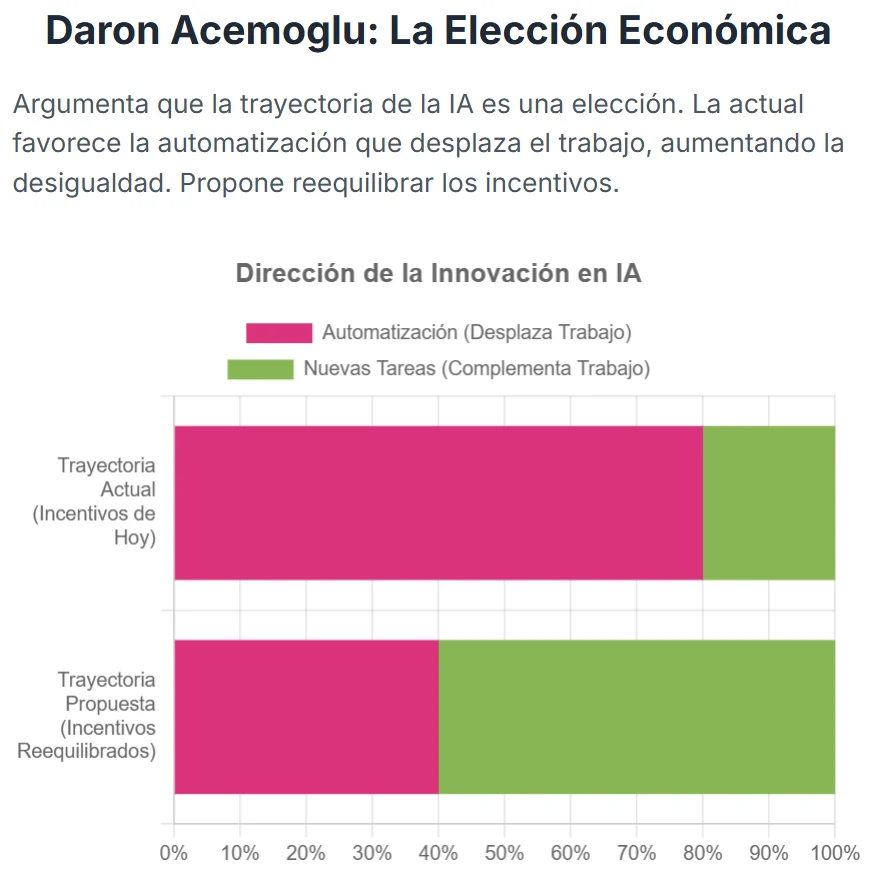
Graphic text, translated: “Daron Acemoglu: the economic choice”. “He argues that AI's trajectory is a choice. The current one favours automation that displaces labour, increasing inequality. He proposes rebalancing incentives.” Chart title: “Direction of innovation in AI”. Legend: “Automation (displaces labour)” and “New tasks (complements labour)”.
Scroll across the table to read all columns.
| Trajectory shown | Automation | New tasks |
|---|---|---|
| Current trajectory (today's incentives) | 80% | 20% |
| Proposed trajectory (rebalanced incentives) | 40% | 60% |
These are the proportions drawn in the original newsletter's illustrative graphic; it provides no data source or measurement method for them.
5. Abeba Birhane
Finally, Abeba Birhane questions the very foundations on which the whole edifice is built. While many focus on “algorithmic bias” as a “garbage in, garbage out” problem, Birhane argues that this is reductionist. The problem is not only that the data are biased; it is the very ontology of data collection.
Inspired by Afrofeminist philosophy, Birhane proposes a “relational ethics”. She argues that current algorithmic systems, especially those used to predict social outcomes, perpetuate harm because they rest on an extractive, decontextualised worldview that ignores the relationships and context of vulnerable communities.
Her work is not merely theoretical: it led to the withdrawal of the vast “80 Million Tiny Images” dataset after demonstrating its deeply racist and misogynistic content. Birhane forces us to ask not only “How do we control AI?” or “How do we distribute its benefits?”, but “Is it ethical, in the first place, to define and reduce human experience to the data these systems consume?”
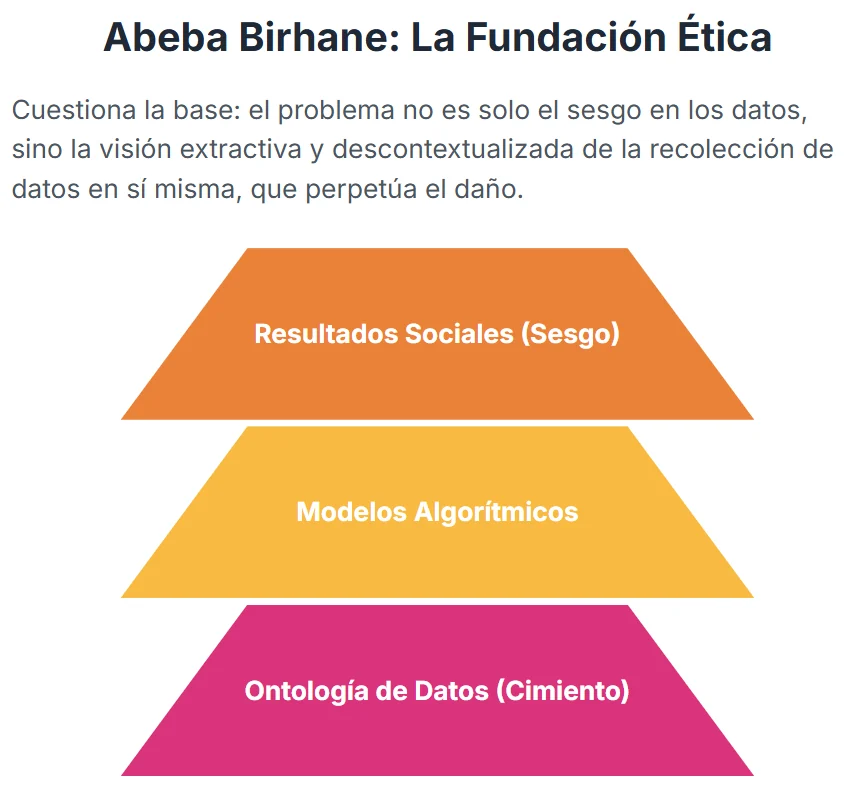
Graphic text, translated: “Abeba Birhane: the ethical foundation”. “She questions the foundations: the problem is not just bias in the data, but the extractive and decontextualised view of data collection itself, which perpetuates harm.” Diagram, from bottom to top: “Data ontology (foundation)” → “Algorithmic models” → “Social outcomes (bias)”.
A strategy with two tracks
These five selected thinkers offer a truly diverse map of AI's intellectual labyrinth. A strategist cannot afford to choose between them. We cannot ignore Aschenbrenner's geopolitical urgency or Cotra's timelines, nor can we dismiss the devilishly difficult technical problem of control raised by Christiano.
At the same time, however, if we focus only on that future existential risk, we risk building a superintelligence on the broken foundations described by Acemoglu and Birhane: a “safe” AI that nevertheless perpetuates structural inequality and feeds on an extractive view of human beings.
The only viable strategy is a “two-track” one: simultaneously addressing long-term catastrophic risks—inherent in a very powerful technology that can do a great deal of good—through governance of frontier compute and massive investment in development and technical safety; while also regulating and redirecting present systemic harms through economic and ethical policies that define the kind of AI we want to build today. In most scenarios, the latter amounts to deciding what kind of world we want to live in tomorrow.
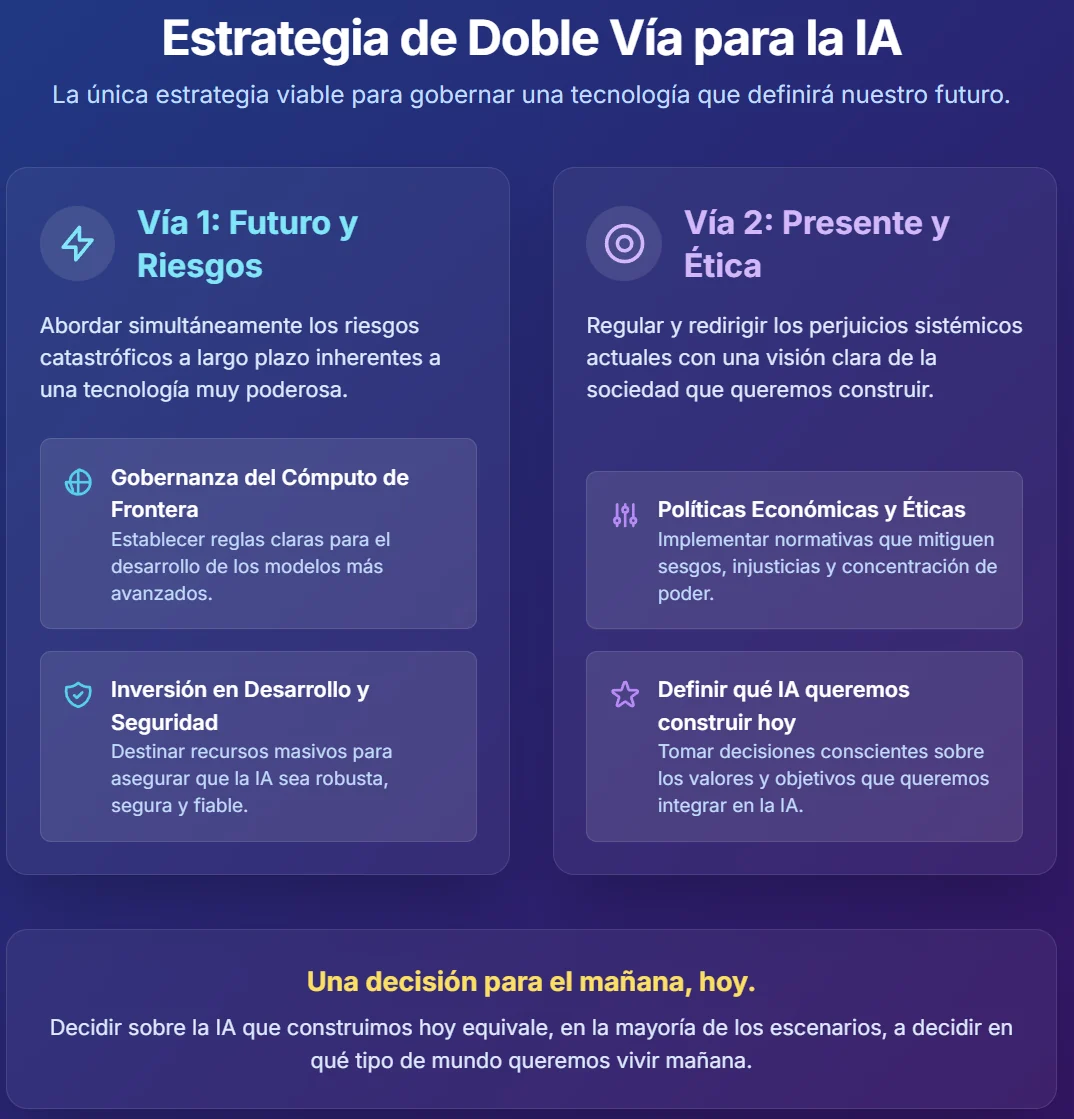
Infographic text, translated:
A two-track strategy for AI. The only viable strategy for governing a technology that will define our future.
Track 1: the future and risks. Simultaneously address the long-term catastrophic risks inherent in a very powerful technology.
- Governance of frontier compute: establish clear rules for developing the most advanced models.
- Investment in development and safety: devote massive resources to ensuring AI is robust, safe and reliable.
Track 2: the present and ethics. Regulate and redirect current systemic harms with a clear vision of the society we want to build.
- Economic and ethical policies: implement regulations that mitigate biases, injustices and concentrations of power.
- Define the AI we want to build today: make conscious decisions about the values and objectives we want to integrate into AI.
A decision for tomorrow, today. Deciding on the AI we build today amounts, in most scenarios, to deciding what kind of world we want to live in tomorrow.
Director of Digital Innovation at Institución Educativa ALEPH and director of estrategIA
Cite this essay
Fernando Nieto Lobato. “Clarity in the age of machines: five thinkers to understand AI and the human future.” estrategIA, issue 108, 22 October 2025. English edition, 29 September 2026. https://elcontemplador.github.io/estrategia-english/essays/108/