Archive note: this article was published on 14 January 2026. Its forecasts and assessments of the technologies presented at CES are preserved as written at the time, without a new verification of those claims. Gary Shapiro's quoted phrase is retranslated from the Spanish source; the original English wording has not been verified.
In estrategIA #17, back in January 2024, we analysed how CES in Las Vegas — arguably the world's most important technology fair — brought promises of holograms and instant translation. The general public has seen far more progress in the latter, which is now almost solved, than in the former. Last year, we used these pages to observe the first steps of AI integrated into our mobile devices, a development that is still under way. This CES 2026 seems to have definitively closed the chapter of “digital curiosity”.
With the lights switched off after the major Las Vegas conferences, the conclusion is unmistakable: artificial intelligence has ceased to be a software promise and become universal critical infrastructure. In 2026, AI has not only learnt physics; it is preparing to be in every citizen's hands.
1. The imperative of universal access: five billion users
Before Jensen Huang spoke to us about robots, Lisa Su, AMD's chief executive, opened the fair with a figure that should be etched into every national strategic plan: AI will reach five billion users by 2030.
The message from AMD and the CTA — the Consumer Technology Association, which organises the event — was forceful: AI has ceased to be a niche innovation and become a universally used technology, comparable to electricity or the internet.
- The political reading: we are no longer talking about regulating a technology sector, but about managing civilisation's basic infrastructure. Gary Shapiro, the CTA's president, described it as the architect of economic change.
- The impact: if AI is going to be in five billion pockets, governments face a challenge of staggering scale. The digital divide will no longer concern who has access to the internet, but who has access to the cognitive intelligence needed to operate in the economy.
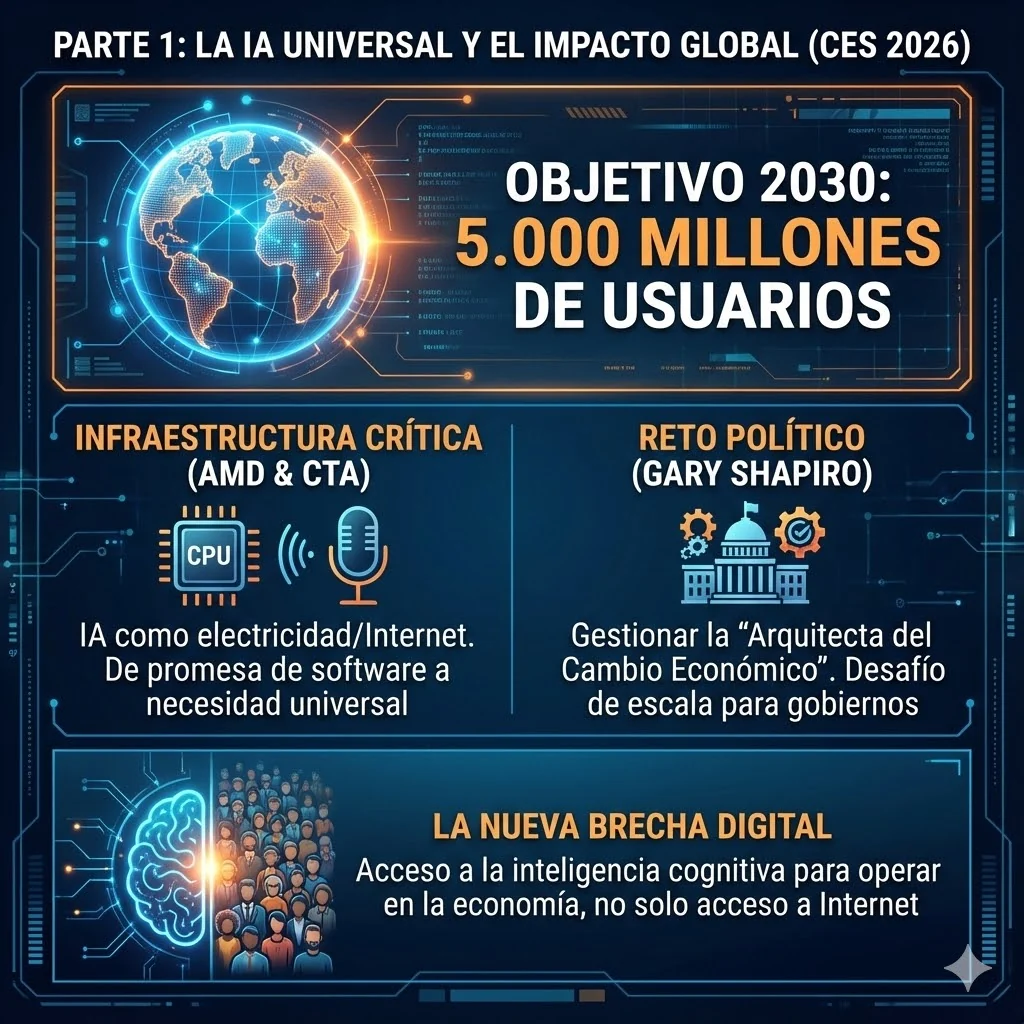
English alternative — Part 1: universal AI and its global impact, CES 2026.
2030 target: five billion users.
- Critical infrastructure — AMD and CTA: AI as electricity/the internet. From a software promise to a universal necessity.
- Political challenge — Gary Shapiro: managing the “architect of economic change”. A challenge of scale for governments.
- The new digital divide: access to cognitive intelligence to operate in the economy, not simply access to the internet.
2. Nvidia and the conquest of the physical world
If AMD supplied the figures for social expansion, Nvidia supplied the engine of physical transformation. In his keynote, Jensen Huang demonstrated that AI has ceased to be merely a chat that writes text and become a force that understands and changes the real world.
- The Rubin platform and Vera CPU: infrastructure for agentic government. Nvidia presented its new “Vera” CPU, designed specifically for “agentic reasoning”. Unlike passive chatbots, these new chips allow AI to plan and carry out complex tasks. For public administration, this means the cost of running “digital civil servants” — agents that process case files 24/7 — plummets, making mass automation of bureaucracy viable.
- Project Cosmos — AI learns physics: perhaps the most fascinating development for urban planning. Cosmos is a model that predicts not words, but the next second of reality, respecting gravity and friction. It is the “Holy Grail” of digital twins: governments will be able to simulate the impact of a flood or a new underground line with perfect physical accuracy before spending a single euro on public works.
- Project GR00T — AI has a body: intelligence steps out of the screen. We saw humanoid robots learning to move through imitation and an understanding of their surroundings, rather than rigid programming. It is the real beginning of Industry 5.0, and of robots as social assistants in hospitals and homes.
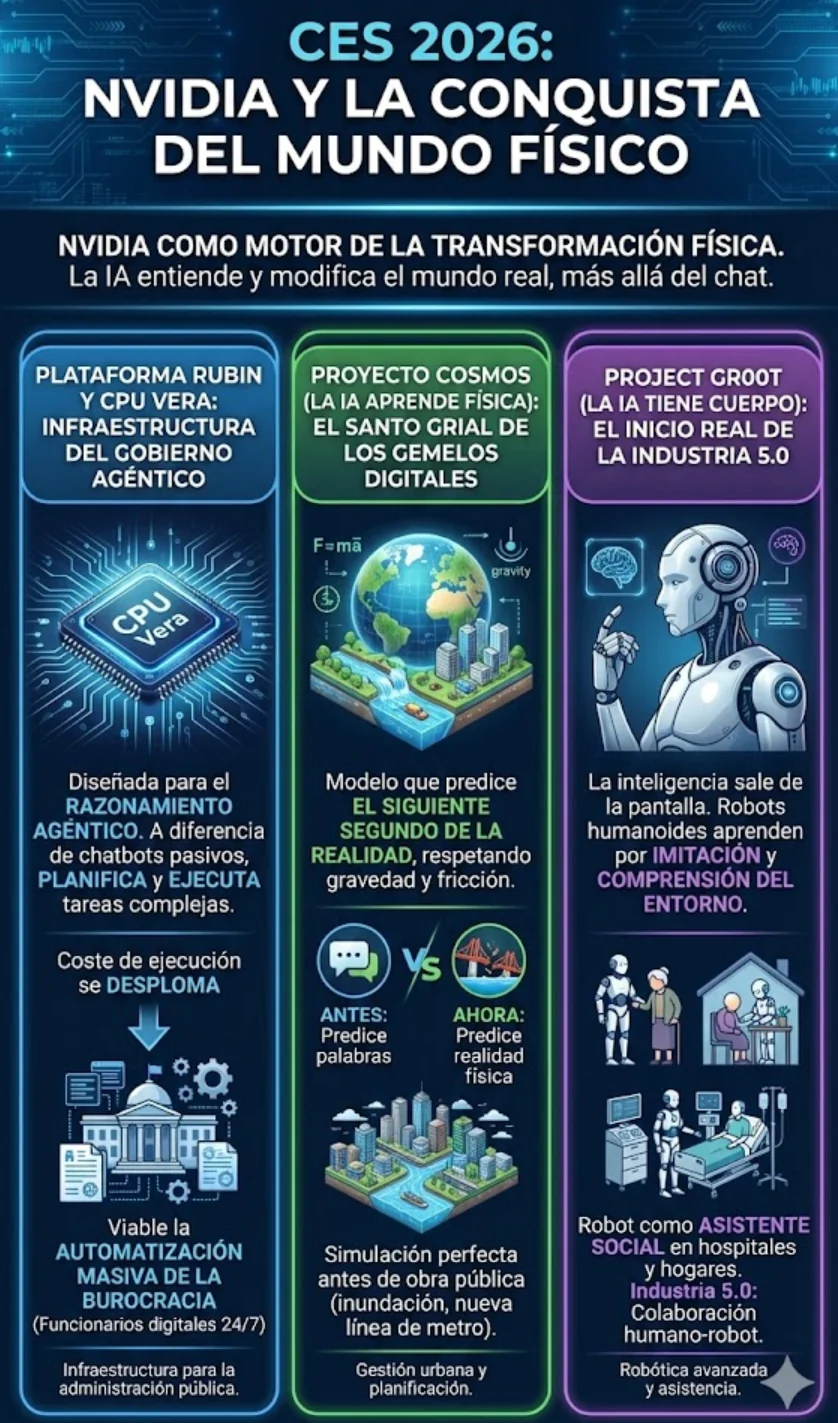
English alternative — CES 2026: Nvidia and the conquest of the physical world.
Nvidia as the engine of physical transformation. AI understands and changes the real world, beyond chat.
Scroll across the table to read all columns.
| Rubin platform and Vera CPU | Project Cosmos | Project GR00T |
|---|---|---|
| Infrastructure for agentic government. | AI learns physics: the Holy Grail of digital twins. | AI has a body: the real beginning of Industry 5.0. |
| Designed for agentic reasoning. Unlike passive chatbots, it plans and executes complex tasks. | A model that predicts the next second of reality, respecting gravity and friction. The illustration includes “F = ma” and “gravity”. | Intelligence steps out of the screen. Humanoid robots learn through imitation and understanding of their surroundings. |
| Running costs plummet. | Before: predicts words. Now: predicts physical reality. | Robots as social assistants in hospitals and homes. |
| Mass automation of bureaucracy becomes viable — digital civil servants working 24/7. | Perfect simulation before public works — floods, a new underground line. | Industry 5.0: human–robot collaboration. |
| Infrastructure for public administration. | Urban management and planning. | Advanced robotics and assistance. |
Although Nvidia set much of the pace, the fair brought other developments worth keeping on our radar because they offer clues to what is coming. We have selected these three:
1. A “pocket cloud” for state secrets. Intel and AMD demonstrated laptops capable of running complex models and agents completely disconnected from the internet. For senior levels of government administration, this makes AI assistants viable from a security perspective in secure environments: analysing sensitive documents, drafting and supporting decisions without data leaving the device.
2. Autonomous food sovereignty — John Deere / Kubota. In agriculture, what we saw were not “tractors”, but AI-coordinated systems managing complete cycles — sowing, irrigation, fertilisation and harvesting — with minimal human intervention. The strategic reading: food security becomes as dependent on compute, energy and maintenance as it is on labour.
3. Under the “Your Companion to AI Living” banner, Samsung strongly promoted the ideas of “Care Companion” and “Intelligent Care”. The aim is to move from reactive care — once a problem has already occurred — to preventive care supported by an ecosystem of mobiles, wearables and the connected home. In its CES material, Samsung describes cases such as early detection of cognitive decline through everyday signals — for example, speech, sleep or gait — and alerts to carers, alongside “AI home monitoring” that analyses video and audio from connected devices to identify potentially dangerous situations and send warnings. The implication for governments: the home is beginning to emerge as distributed welfare infrastructure — ageing, care and safety — with a non-negotiable requirement for explicit consent, data minimisation and traceability, to prevent “caring” from turning into surveillance.
CES 2026 leaves us with two lessons that will define the coming decade. First, the lesson from AMD's opening address: AI will be universal, ubiquitous and available on a massive scale. Second, Nvidia's lesson: AI will be physical, tangible and operational.
For public managers, the message is urgent: digitising administration is no longer enough. We must prepare cities, laws and social services for a world in which, sooner than we think, intelligence will not only be in the cloud, but walking along our streets and caring for people.
Director of Digital Innovation at Institución Educativa ALEPH and editor of estrategIA
Cite this essay
Fernando Nieto Lobato. “CES 2026 confirms a new phase: AI as ‘electricity’.” estrategIA, issue 120, 14 January 2026. English edition, 29 September 2026. https://elcontemplador.github.io/estrategia-english/essays/120/