On 1 January 2025, in estrategIA 66, we published five requests to politicians. The Association for Political Communication (ACOP) featured the article on the cover of the 100th issue of its magazine. The first request was: “Make artificial intelligence a priority.” Almost two years later, Pedro Sánchez and Alberto Núñez Feijóo had more than ninety minutes in their head-to-head debate on 19 November, before an average audience of more than ten million. Neither mentioned AI.
The following day, Anthropic mathematician Levent Alpöge announced that he had proved the Riemann hypothesis with Claude, a mathematical problem, perhaps the world's most famous, concerning the distribution of prime numbers, open since 1859. On Saturday, the Lean and Mathlib teams verified the proof by computer.
In an interview published 36 days before the announcement, Terence Tao, a Fields medallist and one of the world's most brilliant mathematicians, had ventured that perhaps by 2050 mathematicians and AI could make progress on that problem together. It did not take another 25 years: barely more than a month had passed since that interview. On Sunday 22 November, in response to the proof, Elon Musk offered a succinct summary: “Welcome to the singularity” (translated from the Spanish source).
Reading proposals in some manifestos to label AI-generated content, I had the impression that we were still in 2023. The winner may have to live with a superintelligence capable of doing almost any intellectual job better than we can — a prospect that seems increasingly likely to me. I would have liked to hear, at least, the question guiding these five principles in the debate: what should we build so that this AI transformation expands opportunities and freedom for the majority?
1. Governing in the fog
Over the coming years, AI might continue to advance linearly, make a major leap (currently the most likely scenario) or even become inaccessible to us because of decisions made by third countries. During a campaign, we ask a candidate to tell us what they will do over the next four years. If they later change course, we promptly ask why. I would also like to hear their reasons when the world changes and they continue to defend the same plan. In Europe, for example, we might finish regulating a generation of models we have barely begun to build when we are already using the next. For me, that is the difficulty of governing in the fog amid very rapid change.
In this new scenario, it is very important to move from a slow bureaucratic mindset towards one closer to a startup than a century-old administration: faster, more dynamic and willing to change. If what seems exceptional today became commonplace within a year, what should we begin doing now? I would like the next government to ask itself that question often and dare to act while the answer is still being debated. If it later needs to change course, I would ask the prime minister to tell us what they have learnt. There will be times when changing the plan, but not the principles, is the best way to keep a promise.
2. Making access to AI a policy for equality
When, at Institución Educativa ALEPH, we created the first AI tutors for our master's programme as a fully experimental pilot, a free ChatGPT account could not open the custom GPTs we had prepared for students; only paying users could take advantage of them. A commercial condition determined who could learn with them. This reveals a quality gap that in that case was an almost anecdotal condition of the first pilot we created, but that in other circumstances can become a structural divide. Two students in the same class can use AI daily and receive very different help with their learning depending on the models and tools they can access and their training in using them well. Imagine that difference accumulating over all their years of education.
We take it for granted that clean water and electricity should reach every home. I would apply the same ambition to access to the best available AI.
3. Sharing the freedom we may gain
If we were to produce more wealth with much less human work, as I think likely, needing fewer working hours to live well would be good news. I am excited by the possibility that AI could bring us closer to a society of abundance in which we leave behind the biblical curse of work as an imposition — which, although not my own case, applies to many who must go day after day to jobs they detest to support a family. The difficulty would arise if businesses needed ever fewer hours of our work while we still needed our entire salary to make ends meet. Even someone willing and able to work could be left without an income. For that scenario, I would ask that we begin studying a universal basic income now, with a view to its possible introduction in a few years: an income of one's own for every person simply because they are a person, which each individual would retain when taking a job or starting a business.
I think of two people with the same good idea for starting a company. One receives rent from an inherited flat; the other needs their next pay cheque to pay rent. A liberal right might see such an income as a way to extend the freedom to start a business to someone who cannot currently afford to wait for their first customer, and to avoid having to depend entirely on the state in a society where far fewer people work. The left might arrive at the same proposal for reasons of equality. Those without assets should also be able to live well and share in the wealth produced by machines.
If wages lost ground to profits, we would need to explain how to supplement the contributions that fund pensions and how much taxes on business profits and capital income should contribute to public services. The social settlement we inherited from post-war Europe would need to continue protecting us even if the jobs we live on disappeared. Being able to care for someone without losing one's livelihood seems to me a concrete measure of the freedom we could gain.
4. Building so that we can decide
I want Spain to help develop some of the world's best AI models in Europe. That requires infrastructure of our own and shared with our partners, from energy to machines. It also requires continuity for teams that know how to train and evaluate models, and companies able to turn good research into something others want to use. In some fields, it would make sense to train our own model. In others, we should adapt an open model to our languages or buy the best available tool from abroad.
I would apply a test of AI sovereignty to those decisions. If a provider changed its terms tomorrow, could we say no and carry on working? For a university or an SME, that depends on whether it has somewhere to run another model, knows how to adapt it and can afford it. A good measure of European influence would be for someone in another country to choose one of our models to do something that had not even occurred to us.
5. From campaigning with AI to governing with it
I would ask the parties that use AI to make campaign videos and memes to show the same imagination in government. A doctor could spend more time listening to a patient if AI prepared a draft report for her to review and sign. A teacher could adapt a reading to several levels so that a student who had been falling behind could participate. Where administrative processing work decreases permanently, public administrations could reorganise staffing to strengthen public-facing services and devote part of the savings to filling much-needed posts for doctors or teachers.
I would establish a small AI office at La Moncloa, the seat of Spain's prime minister, with direct access to the prime minister and its own budget and technical staff. Before bringing a reform to the Council of Ministers, a ministry could draw on the office, initially — ideally, all ministries would have similar systems — to test its forecasts against data, detect contradictions with other rules and examine whom the requirements might exclude. The minister would remain accountable for the proposal.
In 2025 we asked politicians to dare to “break things”. If one ministry wanted to buy an AI system to review a certificate issued by another, the office could bring them to the same table and ask why they were still requesting it from the citizen. It would have done its job well if, next time, they knew how to resolve the problem without it. What works in a ministry, an autonomous community or a town hall should be available to the others.
Conclusions
Two words stay with me from the interview with Terence Tao. After venturing what mathematicians and AI might perhaps achieve together by 2050, he added: “Who knows?” (translated from the Spanish source). I have been writing about this every week for more than three years, and I could put my name to those two words.
Perhaps superintelligence will take longer than I think. I hope that in four years' time we can say that Spain, Europe and also Ibero-America — where we have hundreds of readers who should have no doubt that these general principles are also applicable to any other country — used that time to build something of their own and improve their citizens' lives. I would regret being right in the forecast and finding, when it finally arrived, that all we had prepared was a good procurement specification to buy it or a committee to study its use.
Director of Digital Innovation at Institución Educativa ALEPH and director of the estrategIA newsletter.
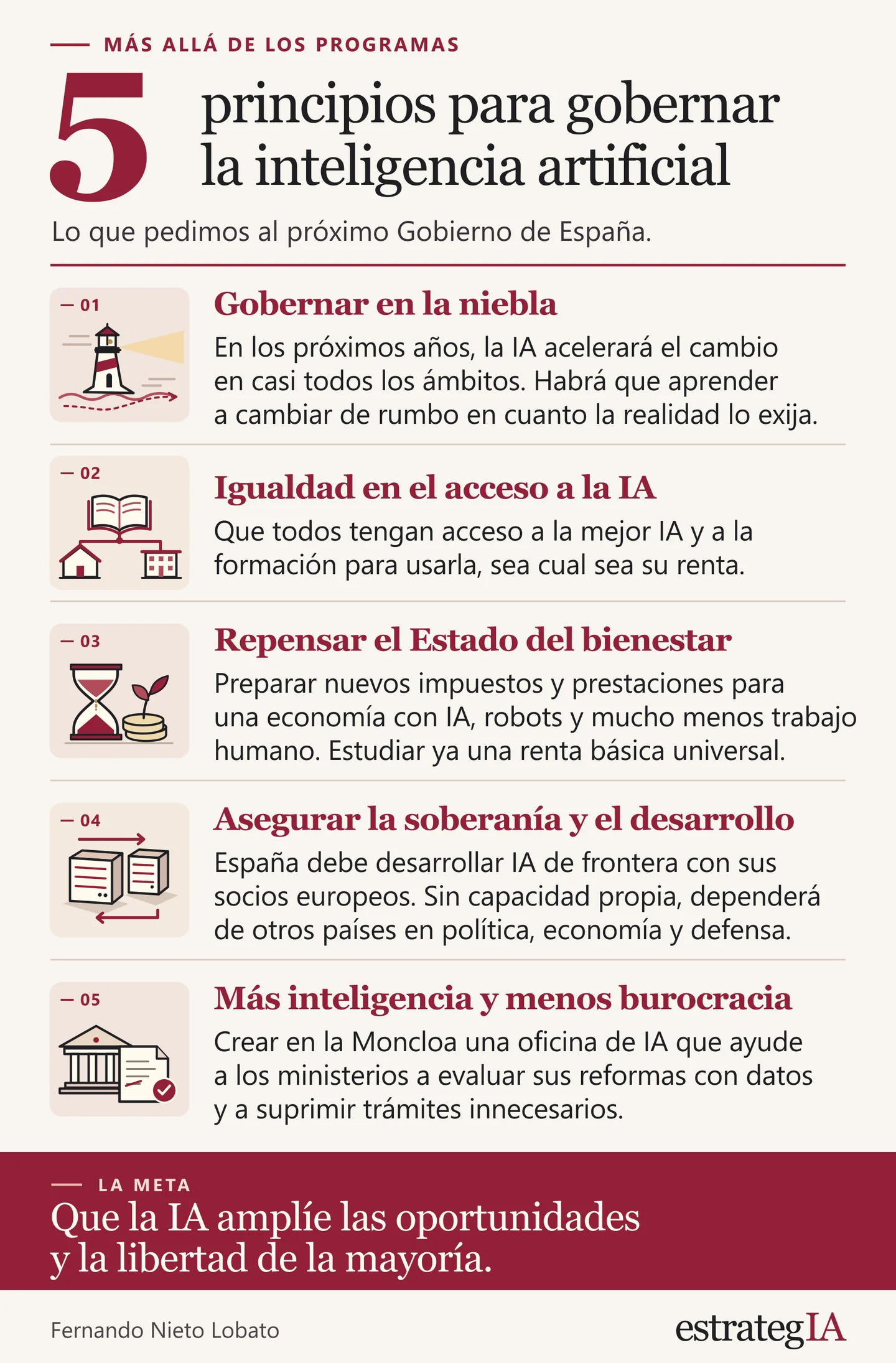
English transcription of the original infographic
Beyond the manifestos: five principles for governing artificial intelligence. What we ask of Spain's next government.
- Governing in the fog. In the coming years, AI will accelerate change in almost every field. We will need to learn to change course as soon as reality requires it.
- Equality in access to AI. Everyone should have access to the best AI and the training to use it, whatever their income.
- Rethinking the welfare state. Prepare new taxes and benefits for an economy with AI, robots and much less human work. Begin studying a universal basic income now.
- Ensuring sovereignty and development. Spain must develop frontier AI with its European partners. Without its own capacity, it will depend on other countries in politics, the economy and defence.
- More intelligence and less bureaucracy. Create an AI office at La Moncloa to help ministries assess their reforms using data and eliminate unnecessary procedures.
The goal: AI should expand opportunities and freedom for the majority.
Fernando Nieto Lobato. estrategIA.
Cite this essay
Fernando Nieto Lobato. “Beyond the manifestos: five principles for governing artificial intelligence.” estrategIA, issue 165, 25 November 2026. English edition, 26 November 2026. https://elcontemplador.github.io/estrategia-english/essays/165/